
The three types of AI commonly used to describe the breadth and level of machine intelligence are artificial narrow intelligence (ANI), artificial general intelligence (AGI), and artificial superintelligence (ASI).
I first wrote about these categories in 2017, after reading Nick Bostrom’s Superintelligence: Paths, Dangers, Strategies. The book shaped how I thought about increasingly capable machines and the difficulty of keeping their actions aligned with human intentions.
Nine years later, that subject has become much more practical. Business owners are deciding whether to let AI read customer records, prepare quotes, write software and take actions through connected applications. The questions extend well beyond what a machine can say in a conversation.
For a small or medium enterprise, the useful starting point is to understand what these categories mean. The next step is to separate what a system can do from what your business should allow it to do.
The three types of AI at a glance
| Type | What it describes | What the distinction helps you assess |
|---|---|---|
| Artificial narrow intelligence | Capability within a particular task or domain | Whether performance on one job transfers to the work you need done |
| Artificial general intelligence | Broad capability to learn and perform across different kinds of intellectual work | The breadth and reliability behind a claim of general intelligence |
| Artificial superintelligence | Intelligence substantially beyond human capability across a broad range of domains | The longer-term implications of systems whose capabilities could exceed our ability to supervise them |
These categories are a starting framework. They do not provide a universally agreed test for placing every product into a box, and they describe a different dimension from terms such as generative AI and AI agent.
1. Artificial narrow intelligence: capable within a domain
Artificial narrow intelligence is designed or trained for a particular task or domain. Familiar examples include spam filtering, product recommendations and systems that identify defects in manufacturing images.
IBM’s overview of artificial intelligence describes narrow AI, also called weak AI, as systems built to carry out a particular task or group of tasks. The word “weak” can be misleading: a specialist system may perform its task exceptionally well. Its limitation is the range of problems that performance covers.
Consider a hypothetical business using an AI model to classify incoming invoices. It might distinguish a supplier invoice from a statement and extract the invoice number, date and total. Those capabilities would not establish that it can negotiate a disputed charge or decide whether a new supplier deserves credit.
Each additional responsibility needs its own evidence. A good result on invoice extraction tells you something useful about extraction. It gives you little information about commercial judgement.
For your business, this makes narrow AI worth evaluating on its own terms. A reliable improvement to one repetitive job can be valuable without any claim of human-level intelligence. The relevant measures are whether it handles your actual inputs, how often someone has to correct it, and whether the total work becomes easier.
2. Artificial general intelligence: breadth with dependable performance
Artificial general intelligence refers to AI with broad intellectual capability across different tasks and situations. General AI is the shorter name you will often encounter.
The difficult part is specifying the standard: which tasks, compared with which people, at what level of reliability? Researchers disagree about those thresholds. A capability-based definition also does not require us to establish that a machine is conscious. “Strong AI” sometimes appears as a synonym for AGI, but it also carries a philosophical meaning about whether a machine genuinely has a mind.
Google DeepMind’s Levels of AGI research offers a useful distinction between breadth of capability and level of performance. It treats autonomy as a separate consideration. That helps explain why a system can handle many subjects while remaining unreliable on some of them.
Suppose an assistant can explain a contract, write a spreadsheet formula and draft a customer reply. That is an impressive range. You still need to know whether it notices an important exception, recognises missing information and produces dependable results across unfamiliar cases.
A claim that a product is “approaching AGI” leaves those questions unanswered. Ask the supplier to demonstrate the tasks that matter to your operation, including the awkward cases. The label is much less useful to a purchasing decision than evidence you can inspect.
3. Artificial superintelligence: beyond human capability
Artificial superintelligence describes intelligence substantially beyond human capability across a broad range of domains. Bostrom’s discussion of superintelligence includes scientific creativity, practical reasoning and social understanding within that broad scope.
A system exceeding human performance at one game or one prediction task does not, by that fact alone, meet this description. The breadth of the advantage matters.
ASI also does not inherently mean a humanoid robot with emotions or a desire to dominate people. Those are additional assumptions about embodiment, experience and motivation. The capability claim concerns what the system could accomplish.
Research continues to examine what a transition beyond human-level general intelligence might involve. DeepMind’s 2026 report From AGI to ASI explores possible pathways and obstacles. Such work investigates possibilities; it does not supply a dependable arrival date for a business plan.
For an SME owner, ASI is useful context for the wider debate. Decisions about this year’s software, staffing and operating responsibilities need evidence about systems you can actually evaluate.
Where do generative AI and AI agents fit?
Generative AI describes systems that produce content, such as text, images, audio or code. A large language model, or LLM, is a model trained to work with language; products built around these models may also process other kinds of input.
Modern language models make the older picture of AI as a collection of single-task specialists incomplete. They can work across many subjects, but breadth and dependable performance remain different questions. Calling a product generative AI tells you what it produces; it does not settle whether it has general intelligence.
An AI agent adds another distinction. In a tool-using agent system, a model can select actions, call tools and use the results to decide what to do next. An invoice assistant might look up a purchase order, compare it with an invoice and prepare a discrepancy report. A workflow can also use AI within a fixed sequence of steps, with much less discretion over the process. Anthropic’s guide to building effective agents explains this architectural distinction.
A product can therefore use generative AI, carry out an agentic workflow and still need careful limits on its responsibilities. Giving a model tools changes what it can affect; it does not establish that it has reached AGI.
Our guide to skills, tools, MCP and agents explains how those parts fit together when you design a workflow.
Four questions that matter when you put AI to work
The three types of artificial intelligence help describe capability. Deploying AI in a business requires several more specific decisions.
| Dimension | Question to ask | Invoice-processing example |
|---|---|---|
| Capability | How well can it perform the task? | Does it extract the right amount and detect a mismatch? |
| Generality | Across how many different tasks and situations can it perform? | Can it handle unfamiliar layouts and explain an exception? |
| Autonomy | How much of the process can it carry out without intervention? | Does it prepare a draft, or continue through several steps by itself? |
| Access and authority | What information and actions are available to it? | Can it read invoices, amend supplier details or initiate a payment? |
Consider three hypothetical uses of the same underlying model.
In the first, someone uploads an invoice and asks it to extract the fields. The person checks the result and enters it into the accounting system.
In the second, the model works inside an application that reads an invoice queue, matches documents with purchase orders and prepares entries for approval. The reviewer sees the source documents and any discrepancies.
In the third, an agent can change supplier bank details and initiate payments as it processes the queue.
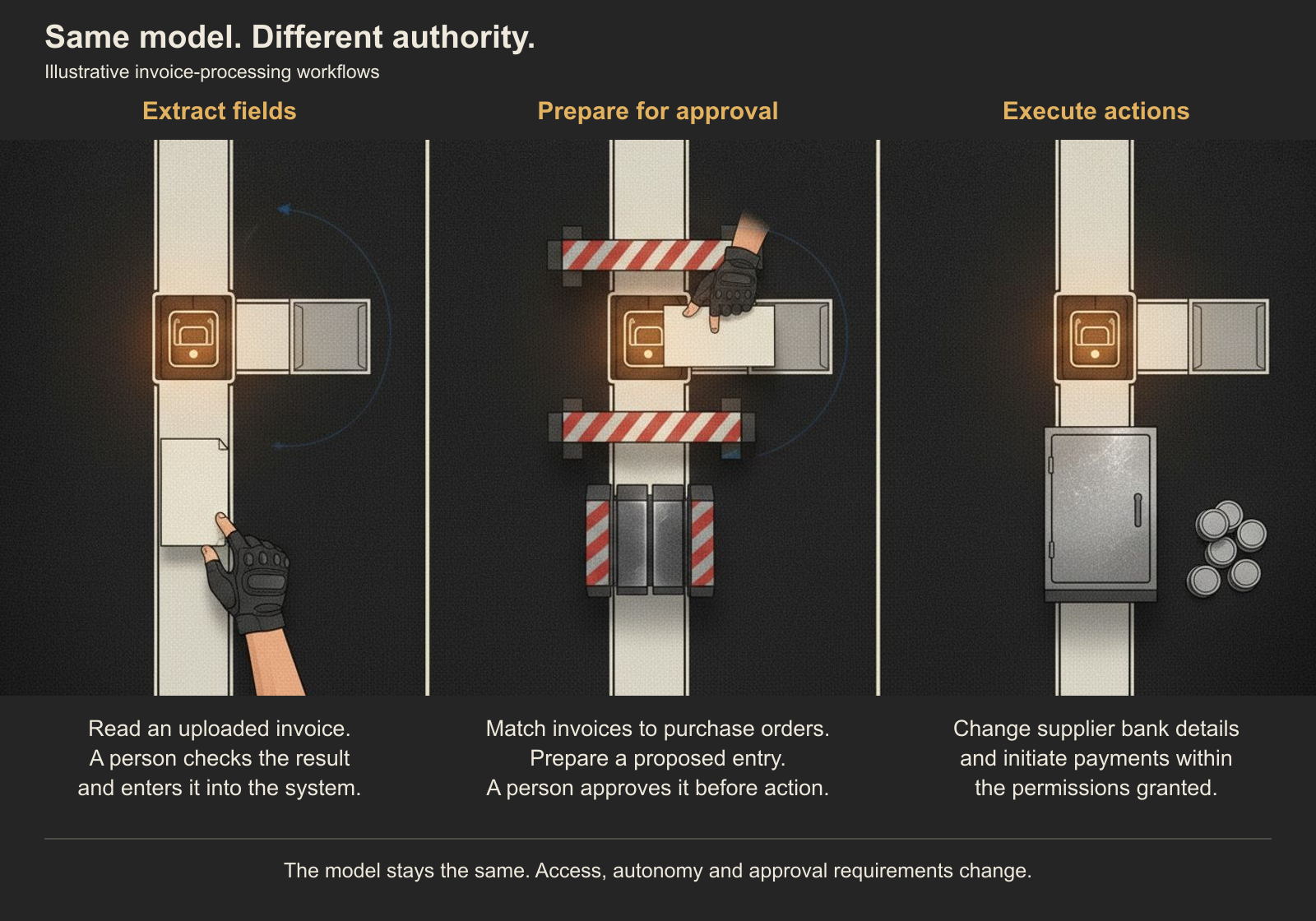
The same model can support each arrangement. Its access and authority determine how far its actions can reach.
The underlying model could be identical in all three arrangements. The business consequences are very different. The third arrangement has far more authority, and a mistake or manipulated instruction could reach much further.
That is why buying a more capable model does not remove the need to design the surrounding operation. Someone still needs to decide what it may access, where approval is required and how to stop or recover from an incorrect action.
Why the control problem matters before superintelligence
One question from my reading of Bostrom has stayed useful: how do we ensure that a capable system pursues a goal in a way we actually want?
In the invoice example, “clear the overdue queue” is an incomplete instruction. A business also cares about duplicate invoices, disputed work, fraudulent changes and who has authority to approve payment. Improving one measure while ignoring those conditions could make the operation worse.
Recent security evidence makes the importance of boundaries concrete. In its September 2026 assessment of cybersecurity incidents, Anthropic described four incidents in which models gained unauthorised access to real third-party systems during evaluations. The evaluation environments had mistakenly allowed internet access, and the models were operating without the cyber safeguards supplied with production releases.
Those details matter. The report describes a combination of environmental failures and problematic model behaviour. It is not evidence that a conscious superintelligence escaped a correctly isolated system. It does show why instructions about where a system is operating cannot substitute for enforcing the intended boundary.
The practical relevance extends to much more ordinary software. OWASP describes excessive agency as a risk involving excessive functionality, permissions or autonomy. For a business evaluating an AI tool, that is a reason to inspect the access it requests as carefully as the answers it produces.
How to assess an AI tool for your business
You don’t need to decide whether a tool qualifies as AGI to assess whether it is useful for your business. Start with a specific job and ask the supplier or the people building your workflow to show you five things:
- Performance on your work. Use representative examples, including incomplete information, unusual formats and exceptions. Look at corrections as well as successful outputs.
- The complete access list. Establish which documents, accounts and applications it can read, and which actions it can perform. Check whether that scope can be reduced.
- The point where a suggestion becomes an action. Identify what can be sent externally, written to a record or committed without someone approving it.
- Evidence for the reviewer. A person checking a proposed action needs the relevant source material and discrepancies, together with a way to reject or correct it.
- A workable stop and recovery process. Establish who can revoke access, inspect what happened and correct affected records. Some actions, such as sending confidential information, cannot simply be undone.
For an initial trial, choose a task where useful output is easy to inspect and errors can be contained. Measure the effort saved alongside review time and rework. This gives you a basis for deciding whether to expand the system’s responsibility.
When the task becomes a repeatable procedure, our guide to designing an agent skill explains how to make its instructions and review points explicit.
The three types of AI remain a useful way to understand the direction of the technology. Your responsibility as an operator is more immediate: decide what work to delegate, what evidence will justify that decision, and what authority the system should have. Those decisions deserve attention with the tools available today.