Why asset software sprawl hides in requests, reminders, and maintenance is easy to misunderstand. An organisation sees an asset register, maintenance platform, booking tool, IT discovery engine, procurement system, finance ledger, spreadsheets, inboxes, and chat reminders, then concludes that it has too many software tools.
The tool count is only the visible symptom. The deeper problem is that no owned operation can answer a more important question: what is this asset, what state is it in, and which recorded event made that state authoritative?
One system knows what was purchased. Another knows who collected it. A technician closed work in a computerised maintenance management system (CMMS). A sensor raised an alert. Finance recorded depreciation. IT discovery found a device under a different name. An email approved disposal. Each surface contains a defensible part of the story, but no owner can reproduce the complete lifecycle.
That is how asset SaaS sprawl grows. Organisations buy a local answer to the next missing handoff while identity, custody, condition, work, evidence, and authority remain fragmented.
Why asset software sprawl hides in ordinary work
The first asset product often solves a real visibility problem. The organisation needs tags, a register, network discovery, maintenance scheduling, equipment reservations, licence management, or fixed-asset reporting. The second product usually solves a different consequence of the same asset.
The stack then grows around the transitions:
- Procurement orders equipment under a supplier and purchase reference.
- Receiving creates a local item, barcode, RFID tag, serial, or temporary spreadsheet row.
- An asset manager classifies it, assigns ownership, and records location or custody.
- IT discovery, telematics, or a sensor observes the same thing under a device identifier.
- A requester books it, reports a fault, or asks for a transfer through a portal, form, email, or chat message.
- Maintenance creates inspections, preventive work, corrective work, parts usage, downtime, and completion evidence.
- Finance records cost, depreciation, impairment, or disposal under its own identifier.
- Security, facilities, insurance, or compliance owners retain another view of risk and obligation.
- A reminder tool chases the next action because the source system cannot express the required exception.
- A dashboard combines extracts without proving which system owns each field.
Every missing transition invites another subscription, integration, spreadsheet, shared mailbox, or report. The result is not merely software bloat. It is one asset lifecycle distributed across tools that use different identifiers, states, timestamps, permissions, and definitions of “active.”
One asset can create several legitimate records
Software visibility is not enough if the audit treats every asset record as a duplicate. Each record may answer a different question.
| Record or observation | What it can establish | What it cannot establish by itself |
|---|---|---|
| Purchase or receiving record | What was ordered, received, and paid for | Current custody, condition, availability, or maintenance state |
| Physical asset register | Canonical identity, classification, location, custodian, and lifecycle state | That discovered technology is secure or accounting treatment is correct |
| Checkout or reservation | Who needs an item, when, and who received it | Long-term ownership, maintenance completion, or financial value |
| Maintenance record | Plans, readings, faults, work, parts, downtime, and completion evidence | Accounting authority, procurement approval, or safe machine control |
| Discovery observation | What hardware, software, service, or device was observed | Whether it is approved, owned, assigned, or the canonical business asset |
| Sensor or telematics event | Where equipment was observed or what condition it reported | The diagnosis, authorised response, or completed work |
| Finance fixed-asset record | Cost, depreciation, impairment, and disposal treatment | Operational condition, custody, availability, or maintenance history |
| Current dashboard | A calculated view of selected data | Which source event, rule, and decision made a state authoritative |
The aim of software consolidation is not to force all of these meanings into one table. It is to name the authoritative record for each meaning, connect them through stable identifiers, and make the transitions reproducible.
ISO 55000:2024 frames asset management around managing assets over their lifecycle to realise value, manage risk, and improve accountability. That lifecycle perspective is broader than maintaining an inventory count.
Where the software waste actually accumulates
SaaS spend management can find contracts, renewals, licence counts, and unused seats. Those are useful inputs, but recurring software costs are only one part of asset software sprawl.
Duplicate identification
Serials, tags, device names, VINs, stock codes, finance numbers, and sensor IDs drift apart. Operators create another row because they cannot safely match an observation to an existing asset. Reports then count one object twice or merge two different objects.
Requests outside the record
Repairs, reservations, transfers, access requests, purchases, and disposals arrive through forms, email, chat, or service desks. The asset system receives only the final update, so it cannot show the rejected request, approval authority, exception, or reason for change.
Reminder machinery
Calendar events, task boards, automation products, and private spreadsheets chase inspections, calibration, warranty, return, licence, and preventive-maintenance dates. When a reminder is acknowledged, nobody knows whether the underlying obligation changed or only the notification disappeared.
Maintenance history split from asset state
A technician completes work in a CMMS while the asset register still says “available.” Parts are consumed elsewhere. A failed inspection creates a message rather than a governed state transition. The operation can show current status or work history, but not how one caused the other.
Discovery without reconciliation
IT and operational-technology discovery produces observations faster than people can resolve them. NIST Cybersecurity Framework 2.0 treats inventories of hardware, software, systems, services, and data—and their lifecycle management—as asset-management outcomes. A scan result still needs reconciliation, classification, criticality, and ownership before it becomes a governed business record.
Reporting without shared meaning
“Active,” “available,” “in service,” “assigned,” “healthy,” and “capitalised” can all be valid and different. Software waste appears when analysts repeatedly reconcile those meanings for each report while dashboards conceal the disagreement.
Access and evidence duplication
Employee assignments, device data, locations, images, inspection evidence, maintenance notes, costs, and contracts spread across tools with different permissions and retention. Removing a licence does not fix copies left in exports, inboxes, integrations, and retired databases.
Connected assets can make tool sprawl worse
QR codes, RFID, GPS, Bluetooth, network discovery, meters, PLCs, SCADA, MQTT, telematics, and condition sensors are not interchangeable “IoT” features.
- Identification says which asset a person or reader encountered.
- Location says where an asset or tracker was observed.
- Discovery says what technology exists and how it appears to be configured.
- Condition telemetry says what equipment was doing at a moment in time.
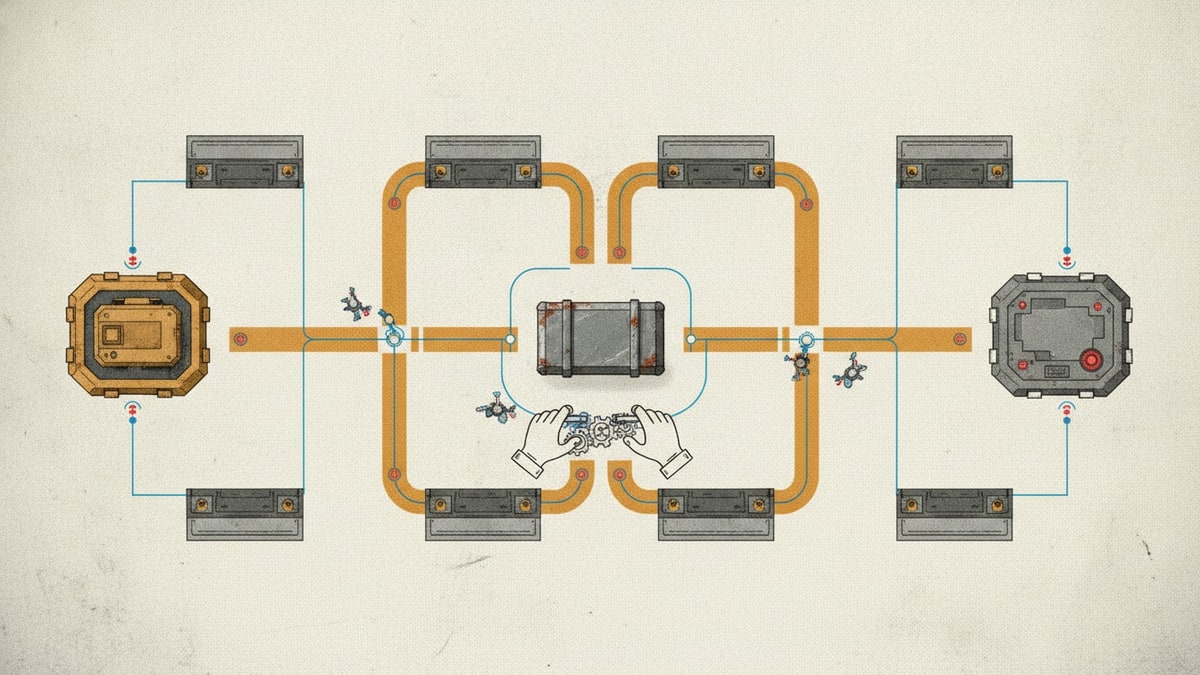
Sprawl grows when every observation source creates its own asset identity and action channel. A sensor vendor sends alerts, the CMMS creates work, a dashboard changes colour, and chat notifies a supervisor—yet retries can create duplicate work and nobody retains the raw observation that triggered the decision.
The safer chain is source observation, canonical asset match, deterministic rule or identified model, proposed action, authorised decision, durable work, outcome, and reconciliation. Artificial intelligence can classify faults, retrieve manuals, detect anomalies, or recommend work. It should not silently invent identity, overwrite source evidence, approve its own diagnosis, or command safety-critical equipment.
SaaS governance needs an authority map
A software stack audit should follow records and consequences, not begin with a cancellation target.
| Responsibility | Common fragmentation | Ownership decision |
|---|---|---|
| Identity | Different tags and external IDs in procurement, operations, IT, maintenance, and finance | Choose a canonical asset and retain mappings to every legitimate source identifier |
| Classification and criticality | Categories are optimised for reporting inside each product | Name the authoritative taxonomy and version material changes |
| Location and custody | Booking, assignment, GPS, discovery, and manual transfers disagree | Separate observations from approved custody and location state |
| Condition and maintenance | Readings, inspections, alerts, work, and completion evidence are split | Preserve source evidence and define who can change operational state |
| Requests and approvals | Email, chat, forms, and service desks imply authority | Create explicit requests, decisions, delegation, rejection, and supersession |
| Financial treatment | Operational tools store cost and depreciation beside the finance ledger | Decide whether operational estimates or accounting records are authoritative |
| Integrations | Sync jobs overwrite fields without durable acknowledgements | Define direction, idempotency, retries, dead letters, reconciliation, and recovery |
| Access and retention | Sensitive copies survive under different permissions | Apply purpose, role, retention, export, and deletion decisions to each record |
This is the difference between SaaS governance and a licence spreadsheet. The authority map reveals which products provide essential infrastructure, which duplicate an owned capability, and which exist because a handoff was never designed.
How to run an asset software stack audit
Choose one asset with a messy history: a transfer, overdue return, repeated fault, sensor alert, repair, loss, discovery conflict, or disposal. Trace it end to end.
- Define the asset consequence. State whether the operation must control availability, custody, maintenance, safety, security, service continuity, financial treatment, or several distinct outcomes.
- Collect every identifier. Find serials, tags, barcodes, RFID values, device names, purchase references, finance numbers, sensor IDs, and external keys.
- Inventory every observation. Include scans, discovery, GPS, telematics, meters, sensor events, inspections, forms, imports, APIs, spreadsheets, and manual updates.
- Separate observation from authority. Mark what was seen, what was inferred, what was approved, and what became the current state.
- Trace requests and decisions. Recover requesters, evidence, approvals, rejections, delegation, exceptions, and reasons for change.
- Follow maintenance work. Link plans, thresholds, readings, faults, work orders, parts, downtime, completion evidence, and reopened work.
- Map adjacent records. Identify what procurement, finance, identity, endpoint security, facilities, and industrial control systems legitimately own.
- Test integration failure. Retry the same event, delay it, deliver it out of order, and disconnect a source. Look for duplicate work and silent overwrites.
- Recover history. Reproduce which state, rule, evidence, and decision applied before a later transfer, correction, or configuration change.
- Export and restore. Recover records, attachments, mappings, history, and audit in usable form, then prove backup and continuity.
- Calculate total cost. Include subscriptions, add-ons, hardware, integrations, support, administration, reconciliation, migration, and operational failure—not only list prices.
- Assign one operation owner. Give an accountable operator responsibility for the lifecycle even where specialist systems retain their own authority.
That output supports software stack rationalisation. It also prevents application consolidation from deleting a necessary record simply because two products both contain an “asset” table.
Four responsible consolidation paths
Retire a duplicate surface
Remove a product when its records and actions are already owned elsewhere, history can be preserved, integrations can be disconnected safely, and users have a complete replacement path. This is the cleanest route to SaaS cost reduction.
Keep specialist systems and integrate them deliberately
Keep discovery, finance, procurement, identity, industrial control, or a mature CMMS when each has a justified authority. Replace ambiguous sync with explicit events, mappings, acknowledgements, reconciliation, and visible failure handling.
Own one focused workflow
Keep the incumbent register and replace one bounded request, reminder, inspection, exception, or approval path. This works when the source and destination authorities are already clear and the focused operation does not become a shadow register.
Own the coherent asset operation
A complete SaaS replacement is credible when the organisation can own canonical assets, identifiers, hierarchy, classification, criticality, location, custody, condition, lifecycle state, maintenance plans, meters, immutable observations, inspections, requests, approvals, work, parts, evidence, permissions, audit, reporting, export, migration, backup, recovery, and continuity.
Accounting, identity, endpoint security, procurement, PLCs, SCADA, and safety interlocks remain adjacent unless a separately evidenced decision brings their records into scope. Ownership is not smaller because those boundaries are explicit; it is safer.
The consolidation decision
Do not ask only, “Which subscriptions can we cancel?” Ask:
- Which asset identity is canonical, and how are other identifiers reconciled?
- Which observations are retained as source evidence?
- Which rule, model, or person can change asset state?
- Who can request, approve, reject, delegate, reopen, and retire?
- Can historical state be reproduced after policies and integrations change?
- Which specialist systems remain authoritative, and what projections do they receive?
- How are duplicate events, retries, partial failures, and corrections reconciled?
- Can all records, files, relationships, decisions, and audit history be exported?
- How will the operation continue when a vendor, sensor, network, or integration fails?
If those answers live in meetings and spreadsheets, software consolidation has not yet created workflow ownership. It has only moved the gaps.
Continue with Best asset management software for the 15-product comparison. Review the incumbent-specific paths in Asset Panda alternatives, Similar to MaintainX, or ServiceNow IT Asset Management replacement. Explore the owned boundary in Asset Maintenance Workflow: how to automate it.
Investigate the record boundary before replacing it
When the audit reaches an authoritative register, maintenance history, connected equipment, several workflows, sensitive data, safety consequences, migration, or continuity, Deep Discovery can define the smallest coherent operation and test which systems to keep, integrate, migrate, or replace. Deep Discovery is currently available through a limited account-enabled rollout.