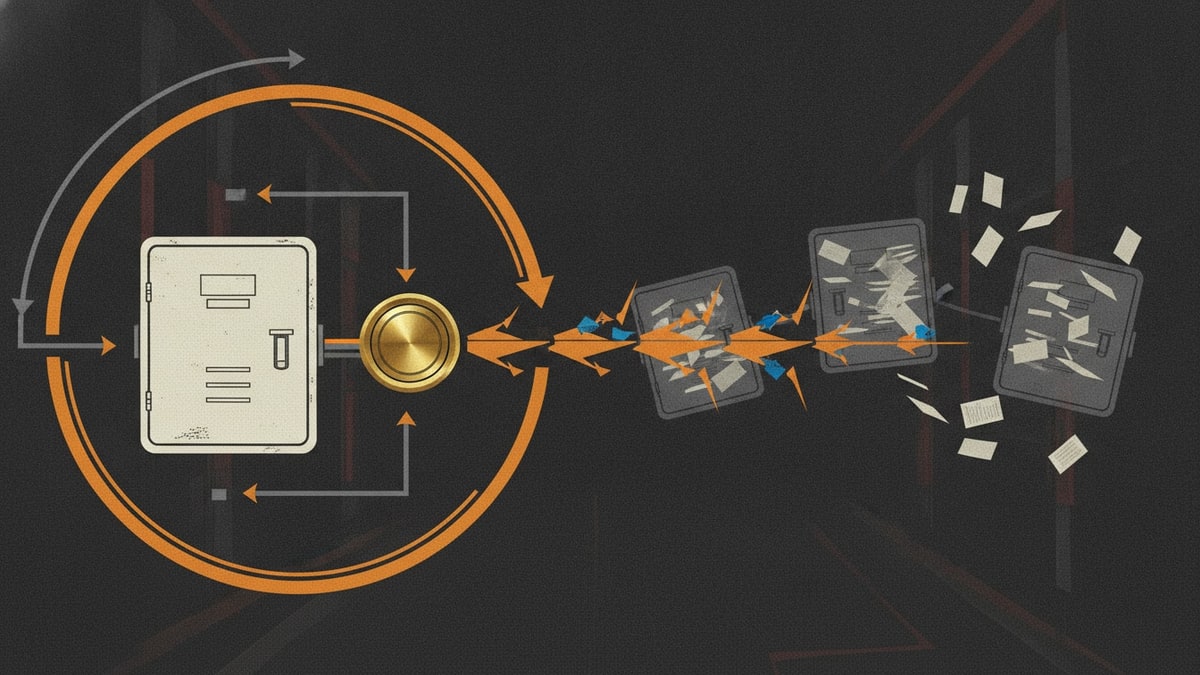
The commercial manager approved the agreement. The customer then changed the service schedule. A signed copy arrived, and somebody marked the deal complete. Six months later, operations discovers that the renewal spreadsheet still uses the original notice period.
Which version was approved? What did the parties sign? Who was supposed to act before the deadline?
That is why contract stacks bloat when approvals sit outside the source of truth. Software as a service (SaaS) sprawl grows as people create extra places to answer questions the shared contract record should already explain.
Why contract stacks bloat when approvals sit outside the source of truth
Consider a fictional maintenance contractor managing customer service agreements and subcontractor arrangements. It has a contract platform, a signing service, shared document storage, an approval board and a renewal spreadsheet.
Those tools are not automatically redundant. A specialist signing service can perform a distinct job. Document storage can serve the wider business. The trouble starts when several tools independently claim to hold the current contract status, approved terms or next decision.
The approval board says “approved”, but does not identify the schedule reviewed. The shared folder contains three versions labelled final. The renewal sheet records an expiry date without the earlier notice deadline. An operations manager keeps a separate list because none of those records identifies the person responsible for the next obligation.
Each workaround begins sensibly. Together, they create an operation that depends on someone remembering how the copies relate.
Tool sprawl is then more than an application-count problem. It is repeated work to reconstruct authority: who decided what, against which terms, and whether that decision still applies.
Approval, execution and fulfilment are different facts
A contract does not have one meaningful “done” state. The business needs connected facts with distinct owners.
| Record or decision | What it establishes | What it cannot establish alone |
|---|---|---|
| Approved version | An authorised person accepted specified terms and attachments | Approval of a later change |
| Execution evidence | The agreement and associated evidence returned from signing | That the business's internal approval process was followed |
| Confirmed obligation | A person accepted an interpretation and assigned responsibility | That delivery has occurred |
| Fulfilment evidence | The responsible person recorded delivery or an exception | Permission to change the underlying commitment |
| Renewal decision | An authorised person decided what to do before the relevant deadline | That a notice was actually sent and received |
Workflow ownership means retaining these distinctions as the agreement changes. The operator should be able to follow an amendment from its source through review, approval, execution and the obligations it changes.
Software visibility improves when the next decision is explicit. “Signed” can coexist with a missing schedule, an unassigned obligation or an approaching notice deadline. Turning the whole agreement green hides that work.
Check the incumbent before adding another approval tool
Fragmented practice does not prove the contract platform lacks controls. Juro's template guidance says changes to approved text or smartfields require reapproval. It also documents reminders on date fields.
If people still approve detached copies or maintain conflicting dates, establish why. The cause might be configuration, the purchased scope, an awkward handoff or a process that bypasses the platform. The appropriate response could be to use the native capability properly.
Too many software tools can also be a symptom of an ownership gap. Nobody has decided who confirms the governing notice period, so another tracker appears. Moving that tracker into a newer application does not make the decision accountable.
The contract management software comparison separates repositories, commercial collaboration and enterprise contract operations. Compare the scope you need before assuming another broad platform is the answer.
Measure the software waste around one amended agreement
Start a SaaS stack audit with an agreement that changed after its first approval. Follow it from the original draft to the current obligation and renewal decision.
Identify where someone copied information and where they had to reconstruct a missing decision. Distinguish avoidable reconciliation from necessary review. Reading a genuinely new liability clause is valuable work. Searching three inboxes to discover which clause was approved is a different activity.
Also distinguish a useful projection from a competing record. Finance may legitimately need contract references in its own system. A report can display the current renewal status without becoming the authority that changes it. The problem is independent editing without an agreed reconciliation rule.
This gives SaaS spend management a practical starting point: the subscriptions and staff effort required to keep one contract understandable. Measure SaaS sprawl through that work before assigning a saving to its removal.
An illustrative cost of keeping contract copies aligned
The following model uses Australian dollars (A$). It is an illustration, not measured customer performance, vendor pricing or a forecast.
Assume 20 changed agreements each month require 30 minutes of avoidable approval-history reconstruction. Add six separate hours copying confirmed dates and owners, plus four hours reconciling renewal reports. Value that work at A$95 per hour and assume A$350 monthly for overlapping trackers and connectors.
| Extra activity or charge | Monthly | One year | Three years | Five years |
|---|---|---|---|---|
| Reconstructing approval history: 10 hours × A$95 | A$950 | A$11,400 | A$34,200 | A$57,000 |
| Copying confirmed data: 6 hours × A$95 | A$570 | A$6,840 | A$20,520 | A$34,200 |
| Reconciling renewal reports: 4 hours × A$95 | A$380 | A$4,560 | A$13,680 | A$22,800 |
| Overlapping trackers and connectors | A$350 | A$4,200 | A$12,600 | A$21,000 |
| Modelled extra cost | A$2,250 | A$27,000 | A$81,000 | A$135,000 |
Workload and prices remain constant. The model excludes tax, inflation, legal review, missed-renewal losses and the main contract-platform subscription. The three activities must be measured separately so the same hour is not counted twice.
Of the monthly total, A$1,900 represents staff capacity and A$350 represents charges. Removing half the avoidable administration would release ten hours, valued at A$950. It would not automatically reduce payroll. Recurring software costs fall only when a charge can actually be cancelled.
A SaaS total cost of ownership comparison must also include implementation or development, migration, parallel running, training, signing charges, hosting, security, maintenance and support. Unused software licences are not removable savings if the commercial agreement prevents reducing the bill.
Use the incumbent's actual invoice and renewal offer for any subscription-retirement case. Juro's current pricing is custom-scoped; a historical public offer to another organisation is not a quote for this fictional contractor. The comparison article carries the available pricing evidence and its limitations.
Artificial intelligence can explain a change without approving it
Artificial intelligence (AI) can compare versions, propose extracted dates and draft an obligation list. Juro already offers extraction, drafting and review, so the presence of AI is not a sufficient replacement argument.
The useful test is what happens when the evidence is incomplete. Give the assistant a master agreement and an amendment that refers to a missing schedule. It should identify the gap, show the sources it used and leave the consequential interpretation for a reviewer.
A helpful summary might explain that the service schedule changed after approval and that the notice deadline needs confirmation. It should not mark the agreement approved, infer that the missing schedule is unchanged or send a renewal notice on its own.
Keep a manual path. Authoritative records should remain usable when extraction is unavailable. Text supplied by a counterparty is evidence to inspect, not permission for the assistant to alter approval rules.
Software consolidation can include the contract system of record
There are three credible routes: configure the incumbent, switch to a better-fitting product, or investigate owning a coherent contract operation.
For the fictional contractor, an owned operation could include the register, counterparties and owners, source documents, versions, approvals, executed copies, obligations, renewal decisions and history. A specialist signing service could remain responsible for execution, with its evidence linked back to the approved agreement.
This would replace the authoritative contract operation, rather than add another approval tracker. It would not need to reproduce every feature sold across the contract-management market. It would need to carry the records and decisions this business relies on.
The boundary has consequences. Migration must reconcile existing agreements, amendments, owners and outstanding commitments. The business needs to confirm what the real vendor export contains; a synthetic sample cannot establish that. Access controls, export and recovery need testing, and a named operator must own the cutover and ongoing service.
When authority moves, the old system must stop initiating competing approvals or signing requests. Rollback must preserve commitments made during the transition. Restoring an earlier database cannot undo a contract the parties have already executed.
Keeping the incumbent is sensible when its native controls work and the cost is justified. Ownership becomes credible when the operation is understood and the business is prepared to maintain it.
Start with the agreement nobody can explain quickly
Before buying or building, ask someone to show the approved version, the executed version and the obligation that applies today. Then ask who owns the next renewal decision and what evidence will show it was carried out.
Use the gaps to compare the configured incumbent, shortlisted software and a proposed owned operation. State which duplicate register would disappear, which specialist services would remain and who would support the result.
The Juro replacement guide develops that decision without assuming the incumbent lacks AI or approval controls. Where records, authority and migration need investigation, explore Deep Discovery, available through a limited, account-enabled rollout.