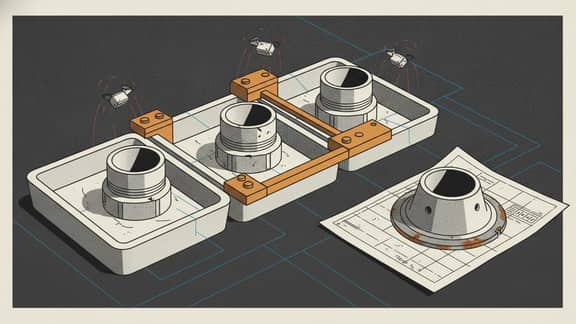
A purchase is approved for 12 pump assemblies. The supplier confirms eight originals and four substitutes. The loading bay receives seven usable units and one damaged unit. Finance receives an invoice for eight.
Every department has an answer. They are answering different questions.
That is why procurement stacks sprawl around request and approval loops. A spreadsheet appears to track amendments, a board tracks missing deliveries, and another report tries to explain the outstanding commitment. Software as a service (SaaS) sprawl grows when those copies become competing purchasing records.
Why procurement stacks sprawl around request and approval loops
Consider fictional Ironbark Field Services, a maintenance contractor buying parts across three customer jobs. Its purchasing operation needs to distinguish what was requested, authorised, ordered, physically received, accepted and billed.
Those are related facts, but a single “done” status cannot represent them all. Approval of the original specification does not approve a more expensive substitute. A packing slip does not establish that the goods arrived in usable condition. An invoice does not resolve the damaged item.
The extra tools often begin as sensible repairs. A supervisor tracks the substitute in email. A buyer adds an exception column to an export. The receiving employee records damage in a shared folder. Finance starts a discrepancy list because the other records do not explain the invoice.
Tool sprawl becomes expensive when each repair carries its own version of the quantity, approval or next action. People spend time making the copies agree, then repeat the exercise when something changes.
This is not an assertion that procurement products lack receiving or amendment features. Procurify documents requests, approvals, purchasing and receiving. Before replacing anything, establish whether configuration, purchased scope or operating practice explains the gap.
Four statuses that must not collapse into one
For Ironbark, give each decision a clear meaning and an accountable owner.
| Fact | What it establishes | What it does not establish |
|---|---|---|
| Approved version | An authorised person accepted a particular specification, quantity and price | Permission for a later supplier amendment |
| Issued purchase order | The business communicated the authorised commercial commitment | Delivery or acceptance of goods |
| Receipt and acceptance | A receiving employee recorded what arrived and what was usable | Approval to pay the supplier |
| Invoice discrepancy | Finance can compare the bill with order and receipt evidence | Physical receipt, acceptance or automatic resolution |
Workflow ownership means preserving those distinctions through changes. The buyer should be able to show the original order beside its approved amendment. The receiver should be able to record eight arrivals, seven accepted units and one damaged-item obligation without marking the entire order complete.
Software visibility improves when the next decision is explicit: the manager owes an amendment decision, the supplier owes a replacement, or finance owes a discrepancy review. A dashboard full of green statuses can hide all three.
What practitioner discussions tell us—and what they do not
In a procurement discussion about fragmented buying, the poster describes purchasing spread across email and spreadsheets and later reports selecting Precoro. That is useful counterevidence to an automatic custom-build recommendation: an existing product may be the sensible consolidation route.
A separate discussion of procurement cost and complexity includes a commenter considering a custom application after evaluating Procurify. Replies challenge the maintenance burden. The reported quote is historical and unverified, and the thread does not establish a successful replacement.
These anecdotes identify questions worth testing. They do not measure how common the problem is or prove that a particular vendor fails. Too many software tools can be a symptom of unclear responsibility as readily as an unsuitable product.
Measure the software waste around one order
Start a SaaS stack audit with a completed purchase that included a change or partial delivery. Follow its identifiers through the request, approval, order, receipt and finance handoff.
Count repeated entry separately from ordinary purchasing work. Negotiating a price, inspecting a damaged part and approving a legitimate exception remain necessary. Re-keying the same approved amount into three trackers is a different activity.
Record where somebody had to reconstruct a decision because its evidence was missing. Identify which subscriptions exist solely to manage those gaps. A report used for a separate accounting purpose is not automatically redundant just because it contains purchase data.
This gives SaaS spend management a useful unit of analysis: the avoidable work around an order, not just the number of applications on an expense report.
An illustrative cost of keeping the copies aligned
The following model uses Australian dollars (A$). It is an illustration, not vendor pricing, a customer result or promised savings. Assume three sites each spend four hours monthly copying purchasing status. Add eight separate hours chasing receipt evidence and six reconciling conflicting reports. Value the work at A$85 per hour.
| Extra activity or charge | Monthly | One year | Three years | Five years |
|---|---|---|---|---|
| Duplicate entry: 12 hours × A$85 | A$1,020 | A$12,240 | A$36,720 | A$61,200 |
| Repeated receipt-evidence chasing: 8 hours × A$85 | A$680 | A$8,160 | A$24,480 | A$40,800 |
| Reconciliation: 6 hours × A$85 | A$510 | A$6,120 | A$18,360 | A$30,600 |
| Overlapping trackers and connectors | A$500 | A$6,000 | A$18,000 | A$30,000 |
| Modelled extra cost | A$2,710 | A$32,520 | A$97,560 | A$162,600 |
Workload and prices remain constant in this model. It excludes tax, inflation, purchasing losses and the incumbent subscription. Measure distinct activities so the same hour is not counted twice.
Of the monthly total, A$2,210 represents staff capacity and A$500 represents charges. Recurring software costs fall only when a charge actually disappears. Recovering an hour does not necessarily reduce payroll.
For scale, removing half the administration and A$250 of charges would release A$1,105 of capacity and A$250 of cash monthly, before the new solution's costs. That is a useful test of a proposal, not a forecast.
A SaaS total cost of ownership comparison must include configuration or development, data migration, parallel running, training, hosting, support, backups and maintenance. If an incumbent purchasing subscription can eventually be retired, use the actual contract and cancellation date. Retained accounting services remain costs. Unused software licences are only a saving when the commercial agreement lets you remove them.
See the procurement software comparison for public pricing and its limits. Do not substitute an old forum quote for a current proposal.
Artificial intelligence can explain the exception, not erase it
Artificial intelligence (AI) can extract a draft from a quote, compare supplier correspondence with the approved order and summarise outstanding deliveries. Procurify already describes AI-assisted intake, so this supporting role is not by itself a reason to replace the product.
The useful test is whether the reviewer can inspect the sources and correct the proposal. A summary should explain that seven units were accepted and one needs replacement. It must not convert the invoice quantity into an accepted receipt because that makes the records balance.
Keep a manual route when extraction fails. Supplier text cannot approve a changed price, confirm physical receipt or authorise payment. A model's confident wording does not change those responsibilities.
Software consolidation can include the purchasing record
There are three credible routes. Configure the existing product when it can carry the work. Switch to a product that demonstrates a better fit. Or assess an owned purchasing operation when its boundaries and ongoing responsibilities are supportable.
For the proposed Ironbark replacement, that operation would own requests, exact approved versions, orders, receipts, outstanding obligations and history. Accounting would retain bills and payments. The purchasing supplier directory would hold operational contact and delivery information, with an external accounting identifier; bank details and payment changes would stay in finance.
That is a system-of-record replacement for purchasing, not merely another tracker. It requires an opening migration that reconciles records and values, a cutover that ends competing approval authority, and recovery procedures that preserve any new transactions. A synthetic rehearsal cannot prove that a real vendor export contains everything needed.
Keep the replacement bounded. It need not reproduce every sourcing, contract, payment and supplier-network feature sold in the category. It does need to carry the records and decisions this operation depends on.
Start with a disputed delivery
Before adding software, ask someone to explain the difficult order from original approval through final acceptance. Show the amended commitment, damaged item, finance discrepancy and remaining delivery. Time the reconstruction and note each missing source.
Use that case to compare the configured incumbent, shortlisted products and a proposed owned operation. State which duplicate register or subscription would disappear and who would maintain the resulting system.
The Procurify alternatives guide develops the switching decision. Our proposed purchase request workflow uses the Ironbark case to explore record ownership; it is not yet evidence of a completed replacement.
Where migration and authority need investigation, Deep Discovery is available through a limited, account-enabled rollout. The first useful outcome is a clear purchasing boundary and a credible keep, switch or own decision.