
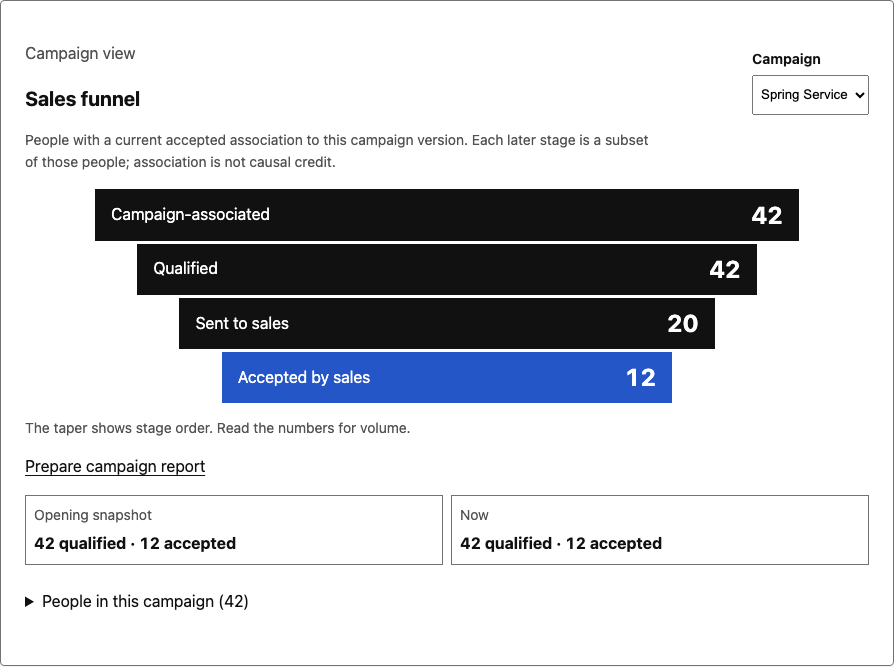
Forty-two people qualified for Marlow Industrial's Spring Service campaign. Twenty were sent to sales. Twelve were accepted. If you run marketing for a smaller business, the number that matters on Monday morning is not just 42. It is whether you can see what happened to the other thirty people and change the next action yourself.
In week 17 of our case-study series, SwarmCraft planned and completed a 75-task build for Marlow Industrial, a fictional Australian B2B equipment supplier. The result is a customer-owned marketing operation designed to replace Marketo Engage inside a defined lead-nurturing boundary. It brings identity, consent, campaigns, delivery evidence, qualification, sales handoffs and reporting into records the business can govern and change itself. Owning those records also gives the operator a place to put AI to work: an embedded Marketing Desk can investigate a specific handoff using cited evidence and prepare a follow-up journey draft for human review.
Marlow and Spring Service are fictional. The marketing manager still faces a familiar question: which of those thirty people need a permitted follow-up, which are waiting on sales, and who can change the rules before the next campaign repeats the same pattern?
Why build when Marketo can do this?
Marketo Engage is not missing a funnel. Adobe documents reports showing leads at each stage of a revenue model, and its Salesforce sync connects marketing and sales records. The case for this build is not an absent Marketo feature.
The question for an operator-builder is whether the business wants to keep shaping its particular process inside a broad platform, or own the smaller operation outright. A Marketo user in a six-person marketing team describes powerful automation alongside a steep learning curve, programmes that can overwrite one another's data, and only two people who understand the administrative side. In another practitioner discussion, a marketer asks whether Marketo's complexity is worth it for their account-based marketing and nurture work. These are individual experiences, not a verdict on every Marketo installation. They make the smaller-business decision tangible: who can understand, change and operate the system you depend on?
For Marlow, we chose to own marketing identity, consent and suppression, audiences, campaign and journey versions, delivery evidence, qualification, sales-handoff state and report history. The customer relationship management (CRM) system still owns opportunities and sales activity; identity and message-delivery providers retain their specialist jobs. In a real replacement, Marketo would be a staged migration source and would cease to be authoritative only after an approved cutover. This is a focused Marketo replacement experiment, not an attempt to clone its catalogue for an enterprise.
For the buying landscape, see Best marketing automation software and Marketo Engage competitors. Why marketing stacks bloat around nurturing and campaign handoffs examines the records and decisions that accumulate between tools.
The dashboard should lead to a decision
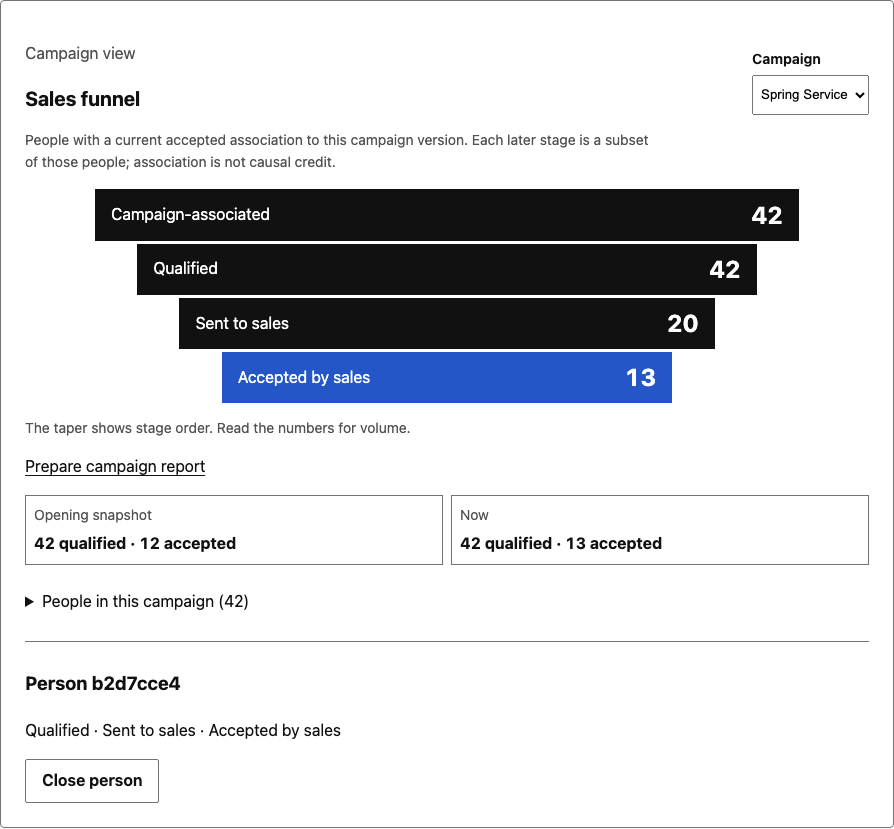
The opening funnel is an operating view, not the differentiator by itself. Twelve accepted out of twenty submitted means eight handoffs still need an answer. Another twenty-two qualified people have not reached the submitted stage. Those counts invite different questions: is a person ineligible for contact, waiting in a journey, missing buying context, or waiting on sales? An operator needs a route from the aggregate to the underlying record before changing anything.
We built the lead nurturing process around that route. A source event resolves to a marketing person; current, purpose- and channel-specific consent determines whether contact is allowed; audience and campaign versions determine what may be sent; delivery and human engagement supply evidence for qualification; and a sales handoff remains pending until the recipient responds. An assignment is not an acceptance, and an email open is not automatically buyer intent.
That is the useful boundary for lead nurturing automation. The team owns the facts and rules that decide the next legitimate action, rather than adding a prettier dashboard to an operation it cannot inspect or correct.
Check permission before preparing the next message
In one tested consent journey, a withdrawal makes the person ineligible to receive the next message. The browser cannot turn an old receipt into current permission, and dispatch checks eligibility again at send time.
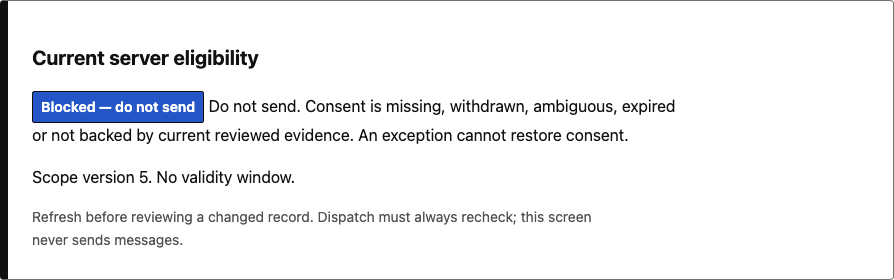
That constraint changes how an email marketing workflow is designed. A campaign manager can review the audience, exclusions, copy, journey and schedule together as an approved version. A later change creates new work to review; it does not rewrite the old approval. A release action rechecks readiness and does not itself send a message.
Ask AI for help, then review the change
The AI-assisted Marketing Desk addresses the practical problem behind the funnel: why has this handoff not been accepted, and what can I do next? In the browser capture, it cites the active identity and assigned handoff, reports that acceptance is still zero, and does not invent a reason sales has not acted.
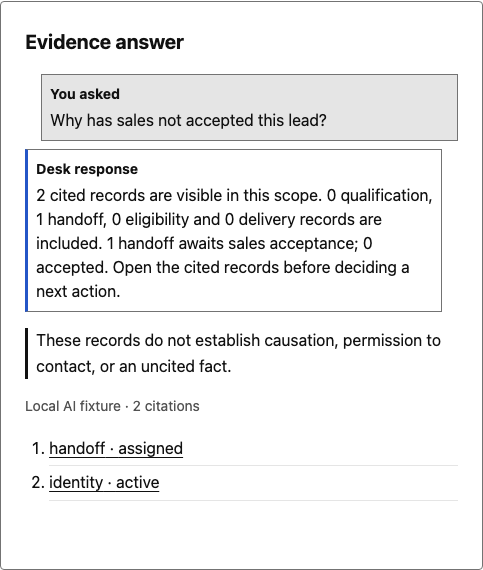
The operator can ask for a follow-up journey draft. Marketing Desk shows the proposed change beside the current state; a person confirms it before the normal server command creates a draft. The result is not a campaign approval or a send.
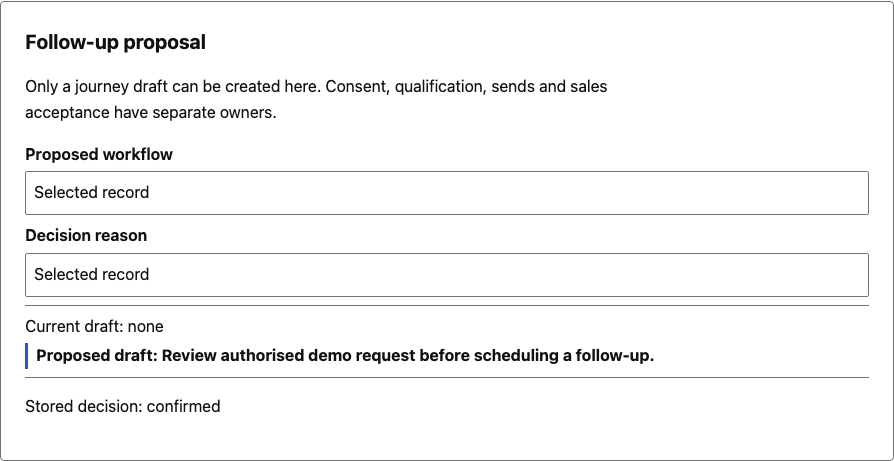
This is the operator-builder advantage we wanted to test. Assistance is embedded where the work happens, but it uses the same permissions, validation and audit as the visual interface. The demonstration uses a labelled local AI fixture and MCP-compatible typed tools; it does not claim a live model or external MCP transport. AI can prepare and explain work. It cannot grant consent, manufacture engagement or accept a handoff for sales.
Sales gets to answer, not just receive
In a separate sales-handoff browser journey, the recipient rejects the first assignment because the buying context is missing. The record stays incomplete, preserves the reason and names who must recover it. After recycling and reassignment, only the recipient's acceptance transfers ownership.
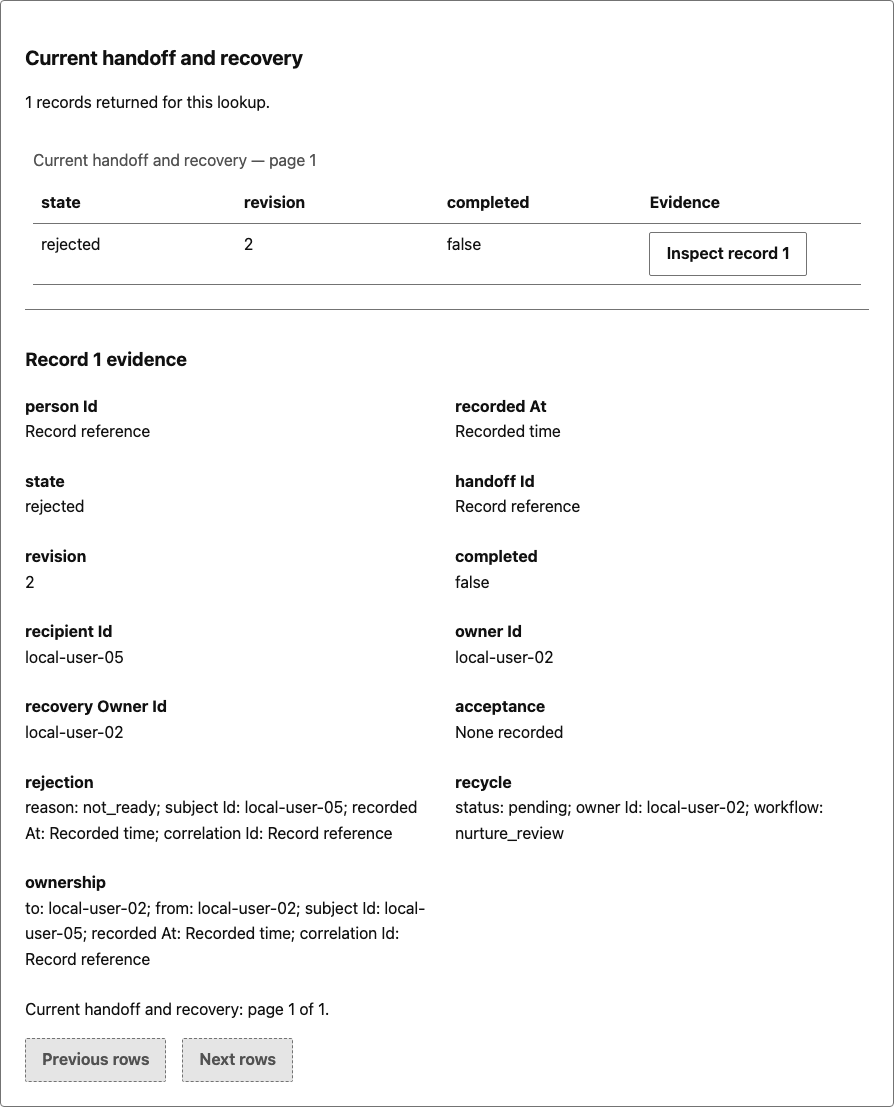
The campaign-cohort journey tests the same counting rule at dashboard scale. It starts at 42 qualified, 20 submitted and 12 accepted. One more recipient accepts, so the current accepted count becomes 13 while the opening snapshot remains 12. These are separate tested journeys, not a claim that one named prospect appears in every screenshot.
An owned sales-handoff rule matters because the business can define what accepted means, preserve a rejection and make recovery visible. That is more useful than reporting every routed lead as a completed handoff.
Keep the report honest when the numbers change
The operator can preview the Spring Service report against the same campaign cohort, approve an exact evidence snapshot and retain a PDF with its version and hash. A local delivery job records simulated provider acceptance and a pending receipt.
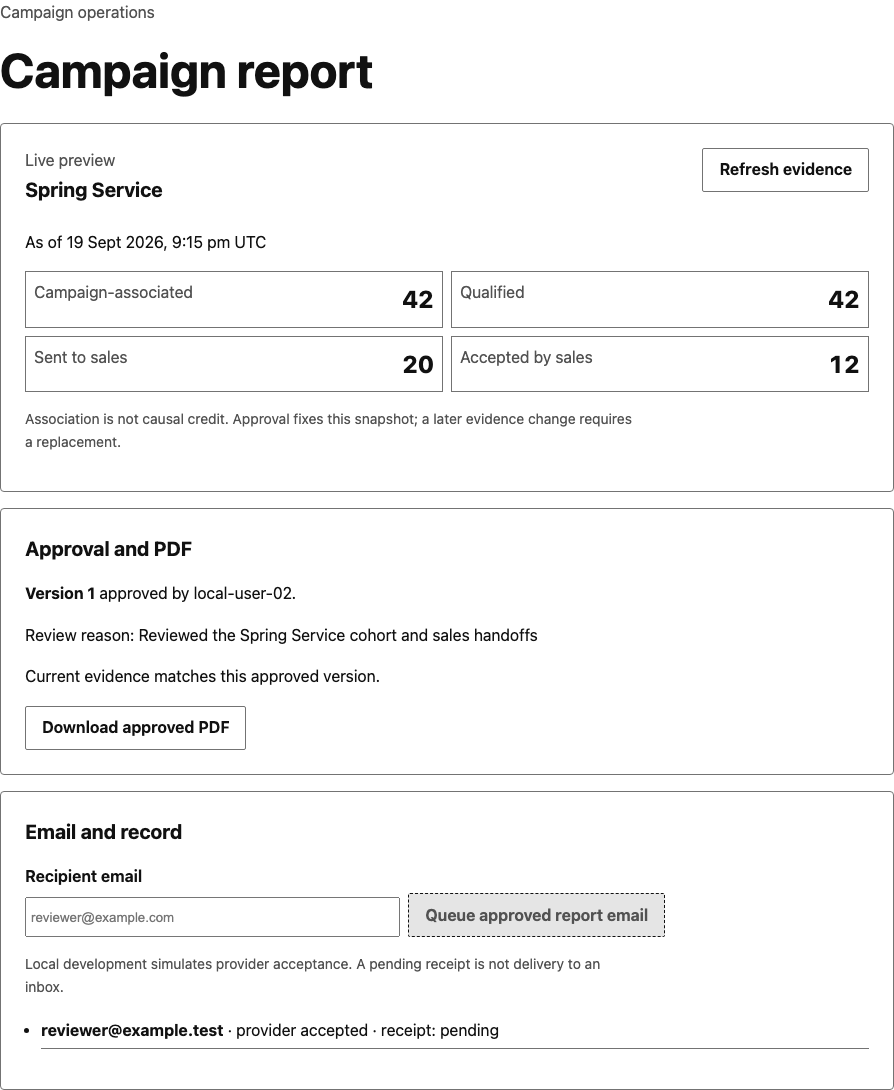
When the thirteenth handoff is accepted, the old report remains available but is marked stale. It cannot be resent as though it describes the current campaign; a linked replacement needs approval. The closing dashboard shows 13 accepted without erasing the earlier 12.
The PDF and approval history are implemented and tested. The email provider response in this demonstration is local simulation, not proof of delivery to an external inbox.
Can the records move?
A replacement is only credible if it has a path for existing records. The migration wizard rehearses an import of fictional Marketo data, quarantines an ambiguous identity and requires correction and reconciliation before an operator can record a cutover decision.
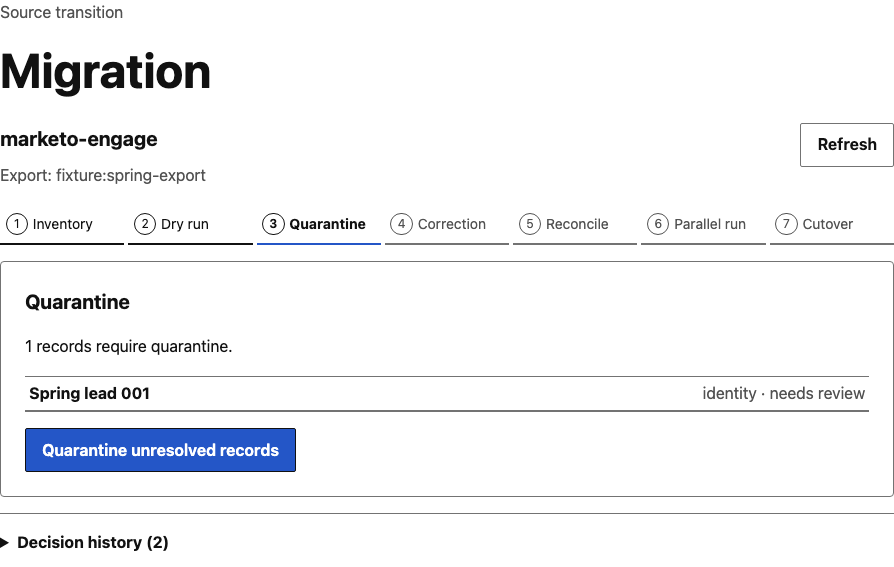
That is one migration proof point, not the story's centre. The rehearsal does not connect to a live Marketo tenant or switch a customer over. Real extraction, identity and consent mapping, delta handling, parallel checks, provider credentials and rollback would require customer-specific work.
What we built and proved
SwarmCraft planned the Lead Nurturing build as 75 task packets, all now in Done. The target repository has a React browser app with a documented black-and-white design system, a Node.js API, PostgreSQL records and 22 versioned migrations. Authentication, authorisation and audit are enforced on the server. Its tests include 102 desktop and narrow-layout Playwright checks and nine PostgreSQL-backed browser journeys; npm run verify passed at article review.
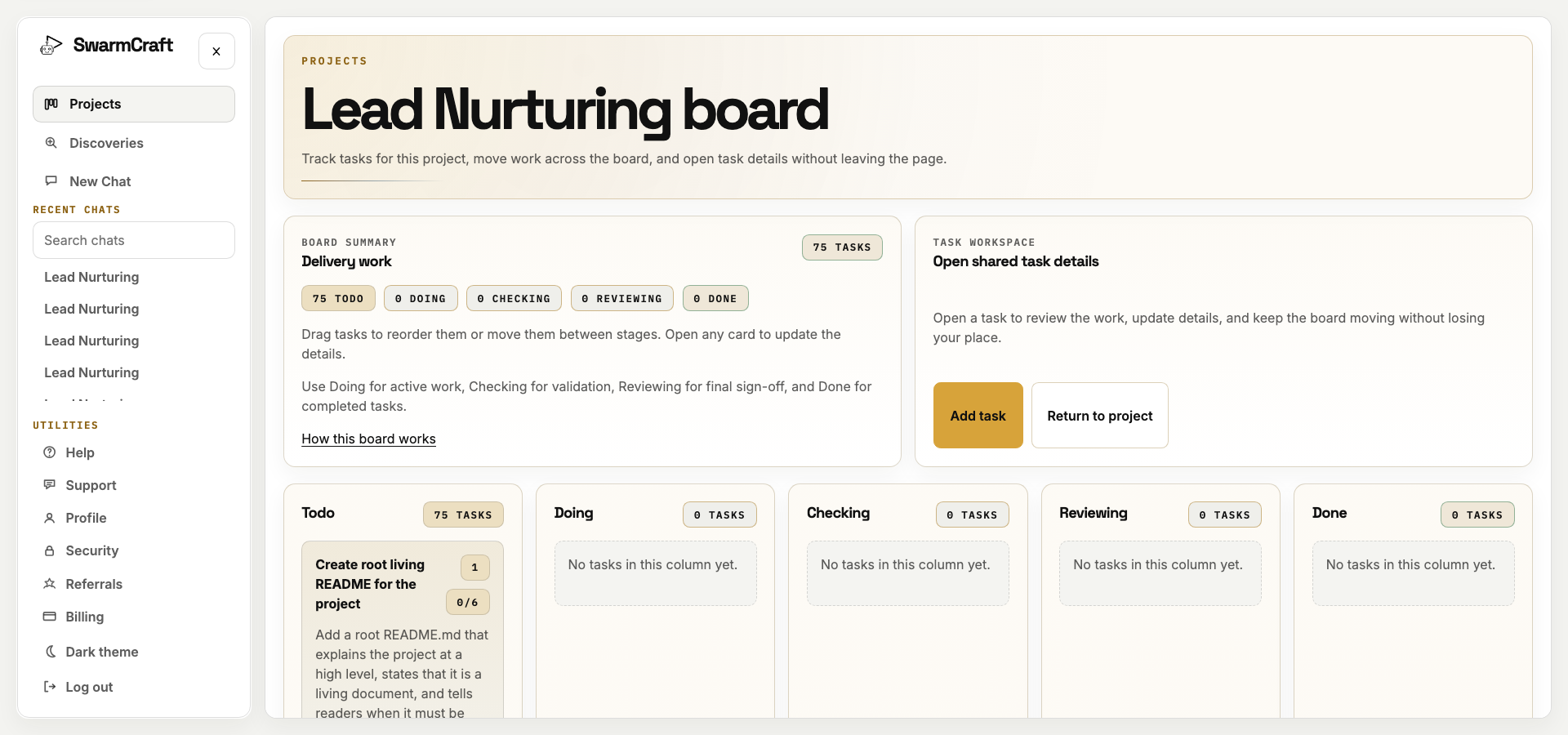
The implementation spans identity and consent, audience and campaign versions, delivery reconciliation, qualification, handoffs, a cited Marketing Desk, versioned PDF reports, migration decisions and audit. The screenshots select focused moments from distinct journeys. They prove the shown states and transitions, not a single continuous named-person journey through every feature or a production deployment.
A live customer operation still needs approved migration and consent rules, production identity and permissions, real CRM and delivery contracts, a configured model if AI assistance is wanted, monitoring and recovery. Those are the next steps for operating the owned foundation, not a reason to treat Marketo feature parity as the goal.
Own the next decision
The lesson of this lead nurturing workflow template is not that smaller businesses need more automation. It is that they can choose a coherent operation they understand: one person record, one current permission decision, one approved campaign version, one accountable sales answer and a report that retains its basis. The dashboard then becomes the beginning and end of useful work, not another place to admire a number.
If you are considering a customer-owned marketing operation, Deep Discovery is the place to work through the records, controls, migration and continuity before committing to a cutover. It is currently available through an account-enabled limited rollout.