Recurring waste
The suite keeps renewing while use keeps shrinking
A broad platform still gets paid for even though the business only depends on one narrow workflow inside it.

SaaS sprawl is what happens when the workflow gets smaller, but the product bundle and recurring cost keep acting like the job is still broad.

Once the workflow gets smaller than the bundle around it, the pain usually shows up the same way.
Recurring waste
A broad platform still gets paid for even though the business only depends on one narrow workflow inside it.
Workflow drag
Spreadsheets, chat, and manual chasing keep surrounding the product because the workflow never really fit the bundle.
Evidence-based scope
Keep the record system for a fast bounded start, or investigate a coherent operation and its records when the evidence supports going deeper.
SwarmCraft is strongest when you want to keep the real workflow but lose the surrounding bloat.
Start narrow
Approvals, intake, onboarding, routing, and narrow reporting surfaces are usually the best first replacement candidates.
Choose the record boundary
Fast Start keeps the trusted record system; Deep Discovery can examine bounded ownership when migration, continuity, and operating risk justify it.
Convert with clarity
The clearer the waste and workflow boundary become, the easier it is to replace the surface without turning it into a full migration.
Start Fast when a focused guided intake can establish the workflow and existing record boundary. Explore Deep Discovery when the waste spans people, sources, records, or conflicting rules.
Start with the fundamentals, then use the related articles to sharpen the replacement case.

Marketing software sprawl grows when profiles, consent, journeys, campaign evidence and sales acceptance describe different versions of the same prospect.

Risk software sprawl grows when the register, assessment evidence, controls, treatments and acceptance history describe different versions of the same risk.

CRM sprawl grows when forms, enrichment, scoring, inboxes, spreadsheets and handoff tools each hold a partial version of the lead while nobody owns the complete sales decision.

Asset software sprawl grows when custody, requests, inspections, maintenance, discovery, finance, and reminders each hold a different partial version of the same asset lifecycle.

Time-tracking subscriptions pile up when approvals stay messy because no operation owns the complete journey from captured evidence to an approved, corrected, reconciled time record.

Resource planning sprawl grows when demand, capacity, proposals, holds, approvals, commitments, and actual work split across tools without one owned allocation decision.

Reporting sprawl begins when governed data, metric definitions, validation, commentary, approvals, and publication split into different tools with no owned operating loop.

HR stack sprawl grows when the HRIS owns employee facts but onboarding, approvals, access, payroll readiness, equipment, and evidence fragment across tools. The safer fix is one accountable employee-lifecycle operation around trusted records.

Support stack sprawl begins when the help desk owns the customer ticket but escalation state fragments across chat, engineering, incident, CRM, and spreadsheet tools. The safer fix is one accountable coordination path around the trusted support record.

Compliance workflow sprawl splits evidence, review, remediation, and approval across tools until nobody can see one accountable path. The safer fix is to consolidate coordination around the trusted compliance record.

Training software sprawl turns one employee learning cycle into repeated reconciliation across the HRIS, LMS, knowledge base, reminders, exceptions, and audit evidence. The safer fix is to consolidate the workflow around trusted records, not replace every system.
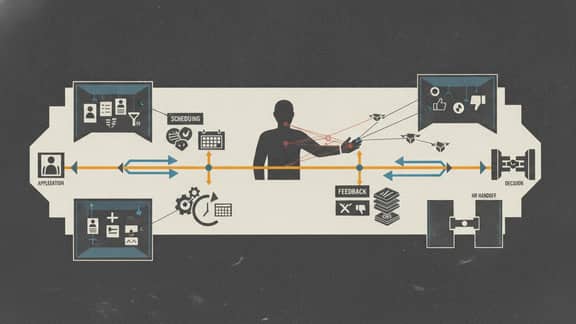
Recruitment workflow sprawl appears when screening, scheduling, notes, and approvals spread across too many tools even though the hiring team still only needs one clear candidate flow.

Document workflow sprawl appears when review, approval, and control work gets spread across too many tools, even though the team still only needs one clear route to trusted sign-off.

Safety software sprawl appears when inspections, incidents, checklists, and actions all matter, but the product surface around them grows heavier than the work itself.

Low-code tool sprawl is getting sharper as builder platforms reposition around apps and AI agents. The risk is that teams buy a governed agent platform when they only need one owned AI workflow with chat intake, review, and report generation.

Project management tool sprawl appears when one coordination job gets split across boards, chat, docs, dashboards, and status rituals that no single team fully trusts.

Workflow automation software gets bloated when teams keep buying broader automation suites to solve one specific approval, routing, or handoff problem.

SaaS bloat happens when a platform keeps growing while the useful workflow stays small, turning features, seats, and admin overhead into drag.

The 2/3 SaaS survival claim matters because AI is making specific application software easier to rebuild, while trusted infrastructure, hard-to-recreate systems, and real workflow context remain more defensible.

SaaS sprawl is what happens when teams keep paying for broad software suites for specific jobs, then accumulate waste, underuse, and workflow friction around the edges.
You have reached the end of this archive.