
SaaS sprawl is what happens when a team keeps adding software faster than it simplifies the work.
That does not always look dramatic. More often it looks normal from a distance: another subscription renewal, another focused workflow added to a broad platform, another team that only uses one useful corner of a product they no longer fully trust.
The problem is not just the count of tools. The problem is the gap between the size of the product and the size of the job the team is still paying it to do.
If you are trying to understand the broader pattern before you decide what to replace, start with the SaaS Sprawl editorial guide.
The search language around the problem
Buyers rarely use one term for the same problem. Some call it SaaS sprawl. Others describe SaaS bloat, software sprawl, app sprawl, or bloated SaaS when a broad suite starts feeling too large for the real job.
They are usually trying to reduce SaaS costs, cut recurring software costs, and stop SaaS waste before it becomes unused SaaS licences or plain software shelfware.
That is why a SaaS audit or SaaS stack audit is only the start. The more useful goal is workflow ownership: understand the focused workflow, then plan a safer SaaS replacement around that surface instead of attacking the whole platform at once.
SaaS sprawl is a workflow-fit problem
Most teams do not resent software because software exists. They resent software when the workflow has become focused, but the subscription keeps acting like the job is still broad.
That mismatch creates familiar symptoms:
- too many seats for too little value
- too many features nobody wants to learn
- too many manual workarounds around the “official” process
- too much recurring spend for a workflow that still feels clumsy
This is why SaaS sprawl is not just a procurement issue. It is a workflow-fit issue. The product bundle keeps growing while the real job the team cares about stays small, specific, and frustrating.
The signs are usually operational, not theoretical
Teams normally spot SaaS sprawl through friction before they name it outright.
They notice that:
- only one small module is actually used every day
- reporting or approvals still happen in spreadsheets and chat
- admins are paying for capability the team has no interest in adopting
- the workflow still needs human patching even after the software rollout
- everyone knows the tool is “too much” for what it is actually doing
None of that means the platform is worthless. It means the relationship between the platform and the workflow has drifted.
Why it gets worse over time
SaaS sprawl compounds because renewal is easier than redesign.
Once a platform is embedded, the team starts working around it instead of questioning whether the remaining job is still big enough to justify the bundle. The vendor keeps shipping new features. The buyer keeps paying for the whole surface. The workflow itself rarely gets simpler.
That is how a product that made sense at the start becomes bloated in practice.
The better question to ask
The useful question is not, “Should we replace this entire platform?”
The better question is, “What is the focused workflow we still depend on, and is the surrounding software now too large for that job?”
That question leads to better decisions because it focuses the scope.
Good candidates often look like:
- approvals and reminders
- intake and triage
- internal ticket routing
- onboarding checklists
- lightweight reporting views
- specific CRM or operations surfaces
These are workflows that matter, repeat, and create pain, but do not always justify the full product stack wrapped around them.
Where SwarmCraft fits
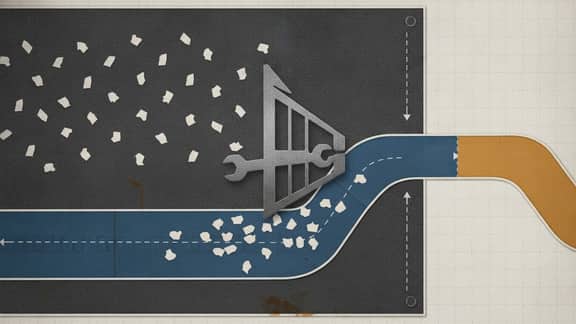
SwarmCraft is strongest when the team wants to keep the important workflow but lose the surrounding bloat.
That means understanding the real work clearly, keeping the system-of-record boundary intact, and replacing only the focused surface that has become expensive, awkward, or overbuilt.
The aim is not platform rebellion for its own sake. The aim is to stop renting more product than the workflow deserves.
The practical definition
SaaS sprawl is the condition where a team keeps paying for broad software suites while only depending on a specific part of the product, leading to underuse, excess spend, duplicated effort, and poor workflow fit.
Once a team can say that clearly, it becomes much easier to decide what to audit, what to keep, and what to replace next.
If the frustration feels less like stack sprawl and more like sheer product excess, the next useful read is SaaS bloat.
If the pain is already pointing toward a concrete process, move from diagnosis into approval workflow automation.
If you want the category-comparison angle rather than the market-pain angle, read Best project management software.
If the team is really asking for a vendor switch, continue with Jira replacement.
If the workflow conversation is drifting toward AI, start with AI workflow automation: a practical guide.
Back on the landing page, the SaaS Sprawl guide keeps the market-pain, supporting articles, and CTA path in one place.
Choose a discovery route
Have one bounded workflow, or need deeper evidence and record-ownership reasoning first? Choose Fast Start or Deep Discovery based on the work and risk involved.