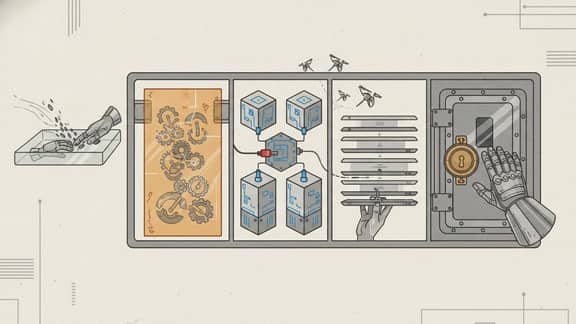
This is week ten of the SwarmCraft workflow replacement case-study series, and the experiment has crossed another boundary.
The first seven weeks kept an incumbent system of record and replaced one workflow around it. Week eight asked whether a small company could own the operating graph at the centre of its compliance programme. Week nine went further and built a multi-workflow support operation around an owned ticket and conversation record.
Week ten applies that progression to people operations.
The narrow version of employee onboarding workflow automation adds forms, reminders, and integrations around an HR platform. That can remove chasing, but it leaves the company renting the employee record that coordinates the work.
We tested a larger proposition:
What if the fast path does not stop at replacing the onboarding workflow? What if it also creates the focused employee system of record that the workflow needs?
SwarmCraft turned that proposition into a 53-ticket customer-managed application. It stages and reconciles an incumbent HRIS migration, keeps effective-dated people and employment history, routes onboarding decisions, records exceptions, projects approved changes to specialist providers, and retains the audit trail that explains what happened.
The product story has three layers:
- Owned employee record. Effective-dated people, employment, organisation, onboarding, decision, integration, and audit records replace the rented HRIS core for a deliberately migrated population.
- AI operations copilot. AI interprets bounded evidence, proposes matches and plans, identifies conflicts, explains confidence, and prepares exceptions without changing an employee record by itself.
- Governed execution. Deterministic software enforces permissions, approvals, lifecycle gates, cutover checks, and retry-safe downstream handoffs before anything reaches payroll, identity, equipment, workplace, learning, or notification providers.
This is not a claim that every company should replace its global HR platform. It is evidence that “the HRIS must remain the system of record” is now a decision to examine, not a permanent law.
If you want the category view first, start with Best HR software. If your immediate problem is duplication rather than ownership, read Why HR stacks sprawl around onboarding, approvals, and handoffs. This article follows the deeper route: owning the coherent operation.
The boundary we chose
The application owns a focused people-operations core for a deliberately migrated employee population:
- effective-dated person, employment, organisation, manager, and onboarding records
- source-import staging, validation, match review, reconciliation, cutover evidence, and bounded rollback decisions
- onboarding requests, actor assignments, lifecycle transitions, approvals, rejection reasons, exceptions, and append-only history
- AI proposals with constrained inputs, source-field citations, confidence, rationale, model reference, and explicit human disposition
- approved downstream projections, delivery attempts, provider acknowledgements, and retry-safe correlation
- roles, capabilities, sessions, access denials, and security audit events
It does not attempt to become a complete global HCM suite. Payroll providers still calculate pay and tax. Identity providers still authenticate users and enforce directory policy. Banks still move money. Equipment and workplace systems still fulfil their specialist work. Screening, right-to-work, benefits, learning content, legal advice, and country-specific employment rules remain with their accountable systems and people.
The owned application coordinates those services from an employee record and decision history the company controls.
That distinction matters. Replacing the system of record does not mean absorbing every specialised responsibility into one codebase. It means owning the smallest coherent record that lets the operation act, explain itself, and change without being shaped by a broad vendor suite.
Project stats
| Stat | Week 10 result |
|---|---|
| Planned implementation tickets | 53 |
| Final board state | 53 done / 0 open |
| Build runner | OpenAI Codex CLI |
| Agent executions | 53 |
| Build-lane runtime | 5h 58m |
| Tracked files after evidence capture | 271 |
| Tracked text lines after evidence capture | 27,909 |
| Test and spec files | 48 |
| PostgreSQL migrations | 15 |
| Unit tests | 126 passing |
| Integration tests | 45 passing |
| Release-evidence checks | 3 passing |
| Reviewed target-system screenshots | 14 |
| SwarmCraft planning screenshots | 2 |
The build completed all 53 selected tickets with no open, blocked, checking, reviewing, or manual-review outcomes. The target repository contains 53 implementation commits after its initial baseline, plus one recovery commit that makes the screenshot evidence reproducible after a locked-desktop capture failure.
These numbers show that an AI build agent can create a substantial production-shaped foundation quickly. They do not show that the system has already run a payroll cycle, completed a regulated migration, survived a restore, or handled the employment rules of every country. Those are operating and assurance tasks for a real rollout.
The employee onboarding workflow inside the system
Seven accountable actors shape the operating model.
| Role | Responsibility |
|---|---|
| New employee | Supplies permitted details, completes assigned steps, and sees their own readiness state. |
| People Operations specialist | Prepares the record, resolves exceptions, reviews AI proposals, coordinates onboarding, and owns completion. |
| Hiring manager | Confirms role, manager, start date, access needs, and whether the person is ready to join the team. |
| Payroll specialist | Receives an approved, bounded projection and owns payroll-specific validation and processing. |
| Identity owner | Provisions and acknowledges access through the organisation's identity controls. |
| Equipment or workplace owner | Fulfils approved device, workplace, or access requirements. |
| People Operations administrator | Manages privileged access, approves migration cutover, and reviews security evidence. |
The employee onboarding process follows this sequence:
- A source import or authorised hire event creates staged, non-authoritative data.
- Validation checks required fields, dates, references, and conflicts before a record can move forward.
- Deterministic matching ranks possible existing people. AI may explain the strongest candidates using only allowed evidence fields.
- A People Operations reviewer accepts, rejects, or overrides the proposal. The suggestion never merges a person by itself.
- Reconciliation compares source, staged, validated, and exception counts.
- An administrator confirms cutover only against current, clean evidence and an approved change reference.
- The owned record stores effective-dated person, employment, organisation, and manager relationships without erasing prior state.
- The onboarding request begins in draft and routes first to the hiring manager, then to People Operations.
- Missing information pauses the request in an explicit exception state rather than hiding the problem in messages or spreadsheets.
- Approved decisions produce versioned, append-only history. A changed start date requires fresh approval.
- Only an approved workflow version can enqueue bounded projections for payroll, identity, equipment, workplace, learning, and notifications.
- Delivery, acknowledgement, rejection, retry, and failure remain visible until every required handoff reaches a trusted state.
- Closure records the final workflow state without deleting the decisions that led to it.
The purpose is not to compress onboarding into one button. It is to give every person, decision, exception, and external handoff a clear owner.
Layer one: the owned employee record
An employee record is not a profile card with a current job title.
Employment changes over time. People join, move teams, change managers, take leave, return, transfer legal entities, and leave. An operational record therefore needs effective dates, stable identities, explicit relationships, versioned decisions, and history that does not disappear when the current view changes.
The Week 10 data model keeps the current state easy to read while retaining the facts that explain it. Actor assignments have effective ranges. Workflow transitions are append-only. Approval decisions can supersede earlier decisions without deleting them. Evidence-bearing relationships use restrictive foreign keys so a person or decision cannot be removed while history depends on it.
The onboarding board turns those records into an operating queue.
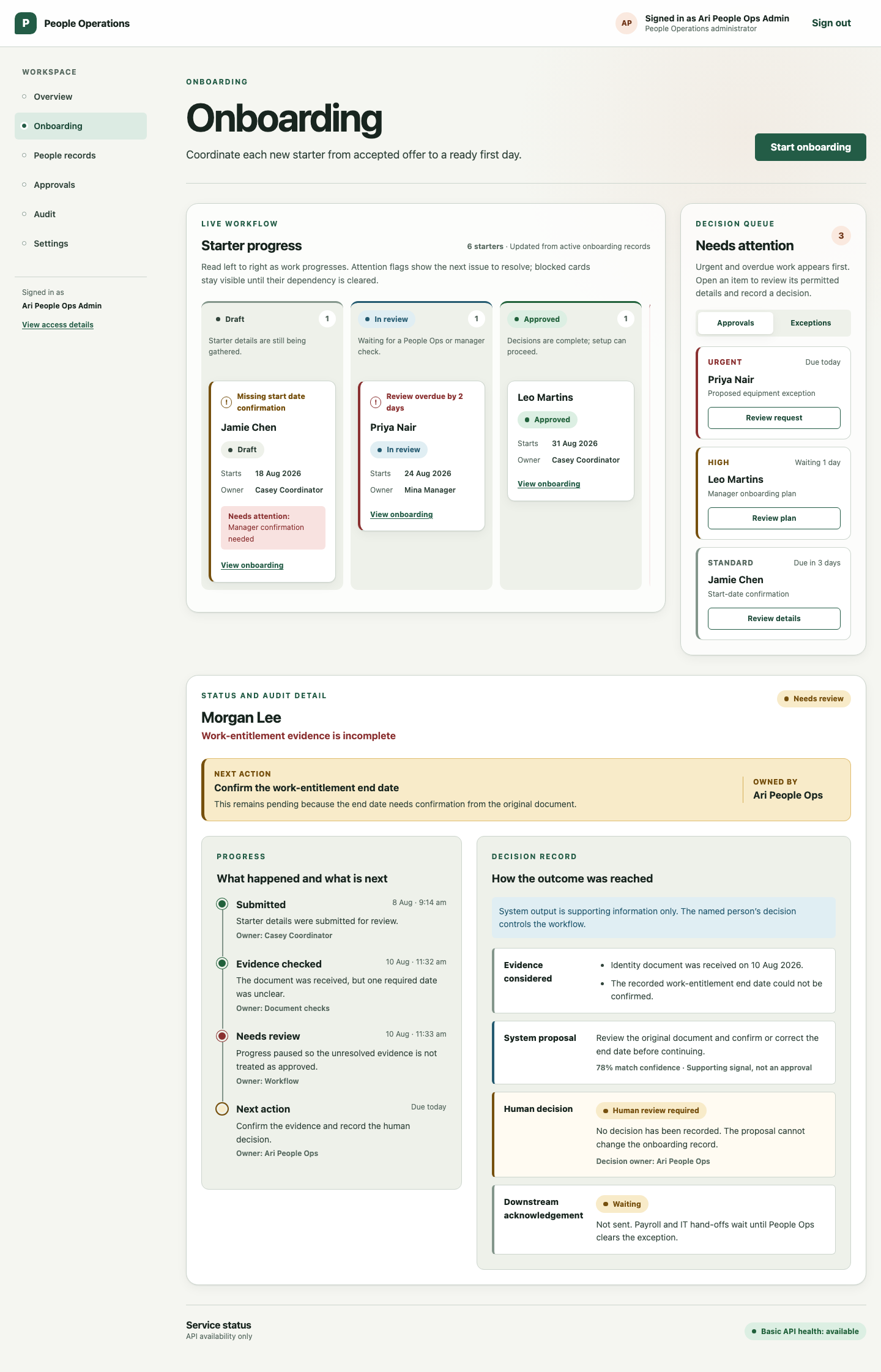
The board is not the system of record by itself. It is a projection over the employee, employment, onboarding, decision, and integration records underneath it. That separation lets the interface change without weakening the history.
Replacing a record starts with migration controls
A credible replacement story cannot begin after the data has somehow arrived.
The import path treats source HRIS data as untrusted and non-authoritative until it passes a governed sequence:
- fetch into a staging boundary with stable source identifiers and idempotent jobs
- map people and relationships without writing directly into the owned record
- validate required fields, dates, duplicate risks, manager references, and unresolved conflicts
- use deterministic candidate ranking and optional AI explanation to prepare match review
- retain the reviewer's acceptance, rejection, or override separately from the proposal
- reconcile source, staged, and validated counts before cutover
- require a privileged confirmation against the latest clean evidence
- record a bounded rollback window that stops after downstream writes, a later cutover, or expiry
That is the difference between importing a CSV and replacing a system of record.
The migration remains a controlled operational event. If counts differ or blocking conflicts remain, cutover fails closed. If newer reconciliation evidence appears during approval, the earlier approval becomes stale. The application records what could be rolled back; it does not pretend that deleting a batch is safe after other systems have acted on it.
Layer two: the AI operations copilot
The strongest role for AI in people operations is interpretation, not authority.
An onboarding copilot can turn messy hire information into a proposed structured plan, compare staged records with existing employees, point out conflicting dates or relationships, prepare an exception packet, and explain why a case is not ready. But a useful copilot must show its work and operate inside an explicit data boundary.
The implemented AI matching slice does that narrowly:
- deterministic software first ranks candidates using source identifiers, external references, work email, name, and start-date proximity
- the AI provider receives at most five temporary candidate aliases, confidence signals, matching field names, and date differences
- it does not receive names, email addresses, identifier values, employee IDs, documents, protected attributes, or raw source payloads
- output must contain the exact structured fields for candidate, confidence, rationale, and citations
- every citation must refer to an allow-listed field that the local comparison actually matched
- the stored draft retains its model reference and remains separate from the authoritative employee record
- a reviewer must accept, reject, or override it before any later authorised workflow can change data
The status surface shows the intended human-AI relationship: a system proposal, the evidence and confidence behind it, a human decision, and the governed downstream result.
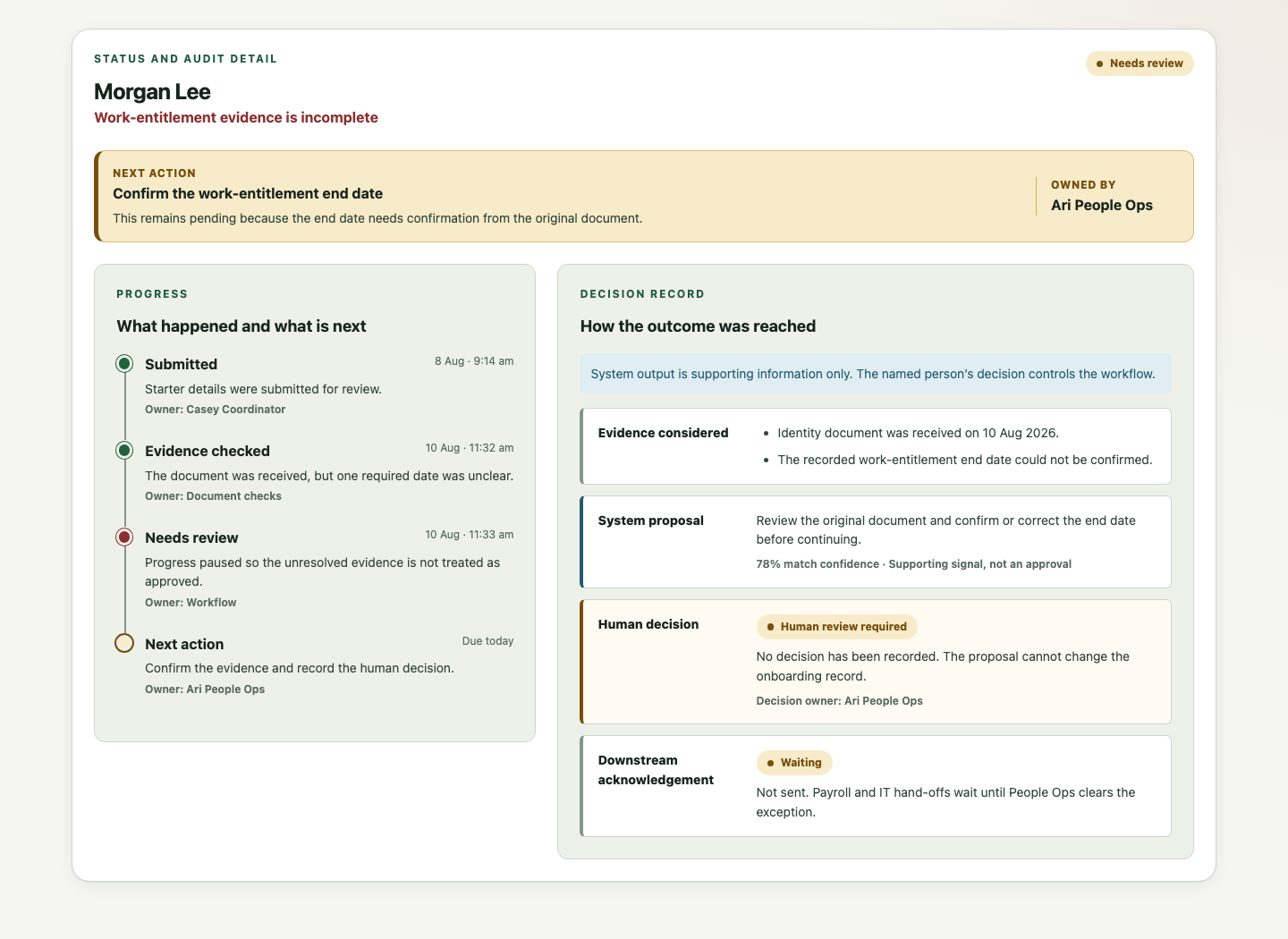
The screenshot uses deterministic local evidence, not a live model call. The production-shaped adapter, de-identification rule, output validation, citation checks, model reference, failure contract, and review boundary are implemented. Connecting and evaluating a chosen live model remains production work.
That boundary aligns with the NIST AI Risk Management Framework, which treats governance as a cross-cutting function and calls for defined responsibilities in human-AI configurations. The important design choice is not merely putting a person “in the loop.” It is making clear what the AI can see, what it may propose, who can decide, and which deterministic control executes the result.
The broader copilot can grow from this foundation. It can assemble onboarding plans from approved templates, identify conflicting policy inputs, summarise readiness, draft employee communications, and prepare exceptions. Each new capability should retain the same contract: bounded context, evidence, confidence, version, review, and no direct authority over employment decisions.
Layer three: governed execution
Once people have decided, ordinary software should execute the decision predictably.
The server owns seven onboarding states: draft, pending_review, needs_info, approved, rejected, withdrawn, and closed. Policy checks require a valid starter and start date, active manager routing, resolved information, matching manager and People Operations approvals, stable reason codes, and reapproval after a material date change.
The browser can explain which actions appear available, but it is not the authority. The API reconstructs eligibility from persisted state and the authenticated actor before accepting a transition.
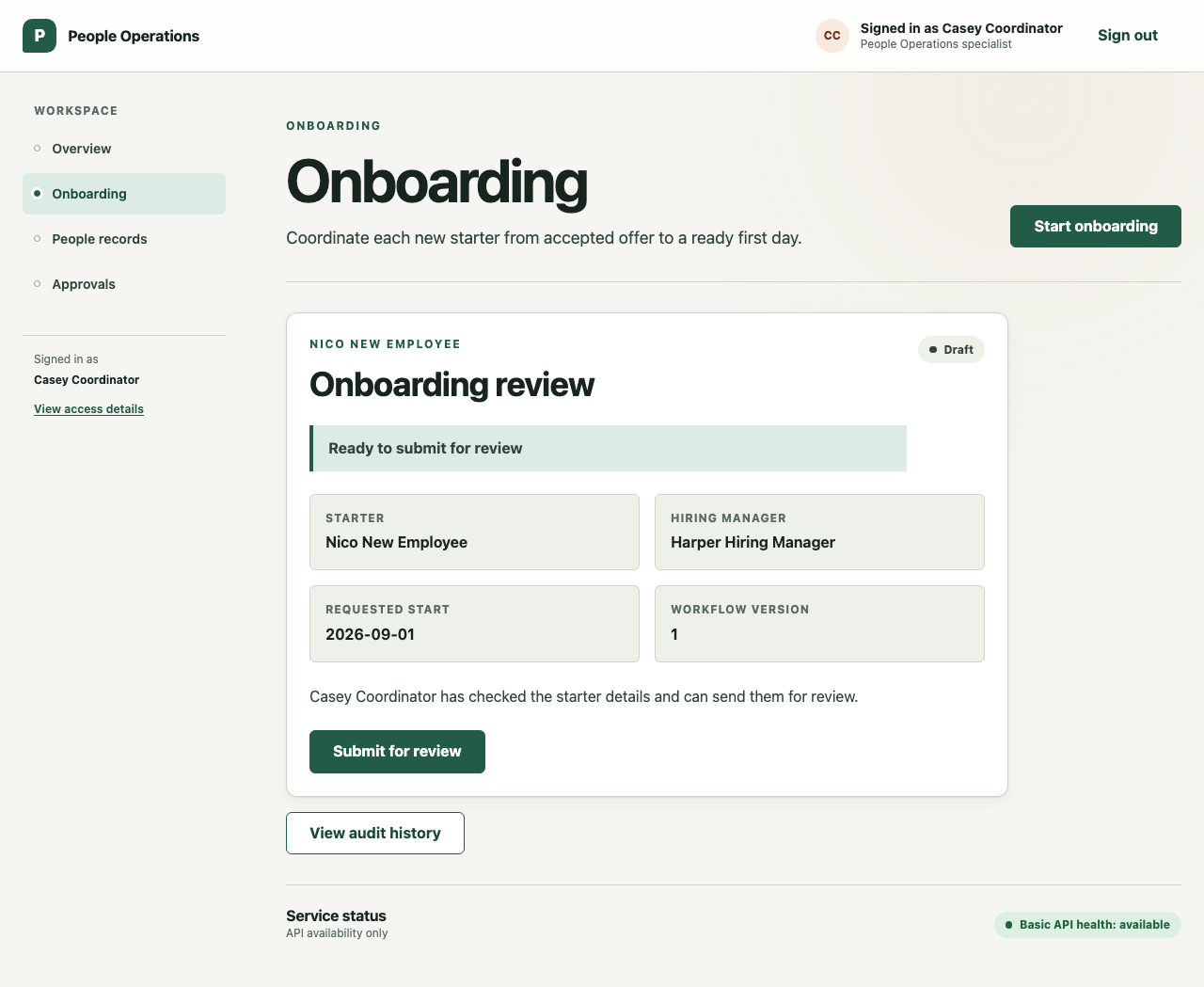
The happy path begins as a visible draft rather than an invisible chain of messages.
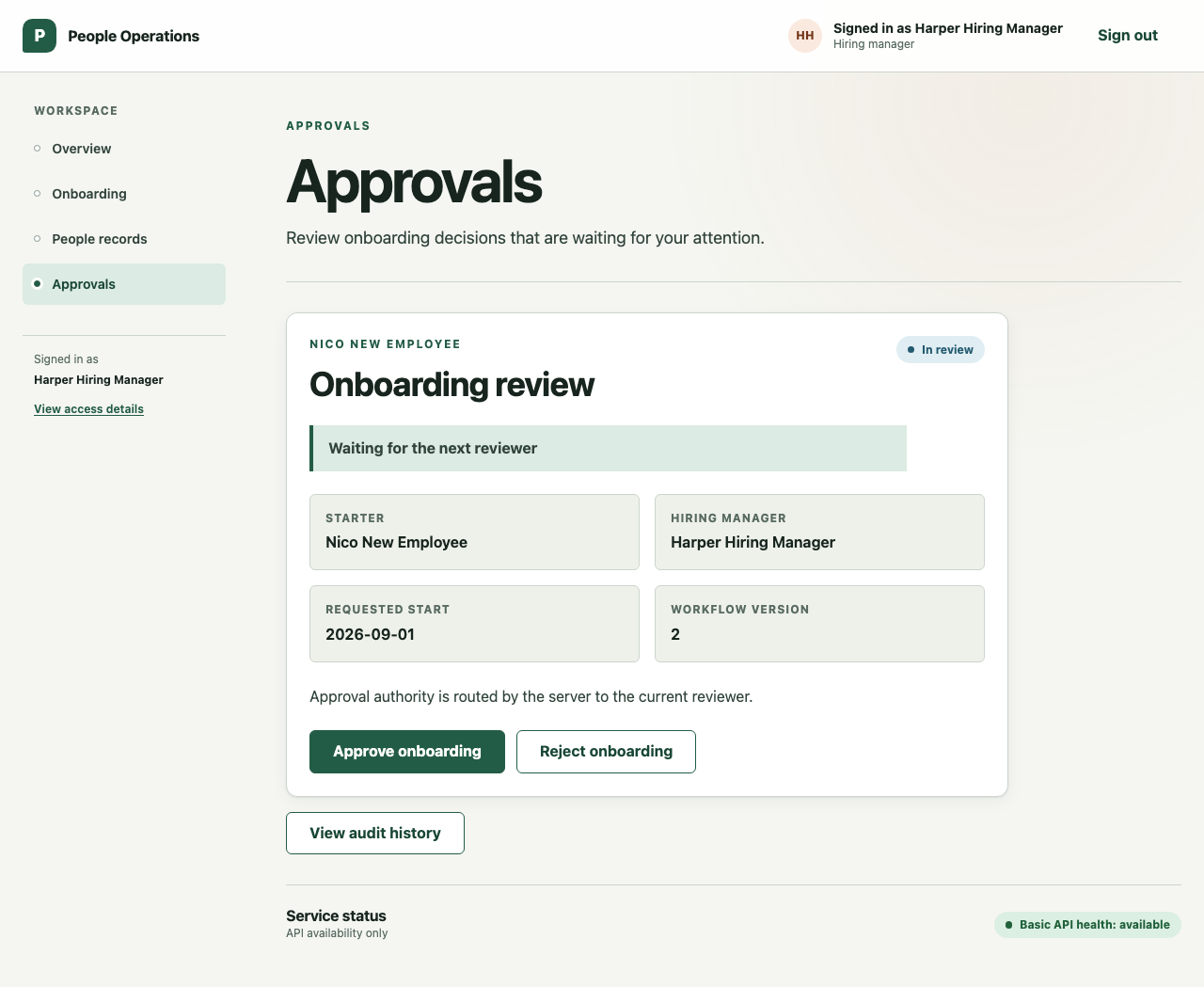
The hiring manager then receives a bounded decision rather than a generic approval link.
After manager and People Operations approval, the workflow records the effective decision before integrations begin.
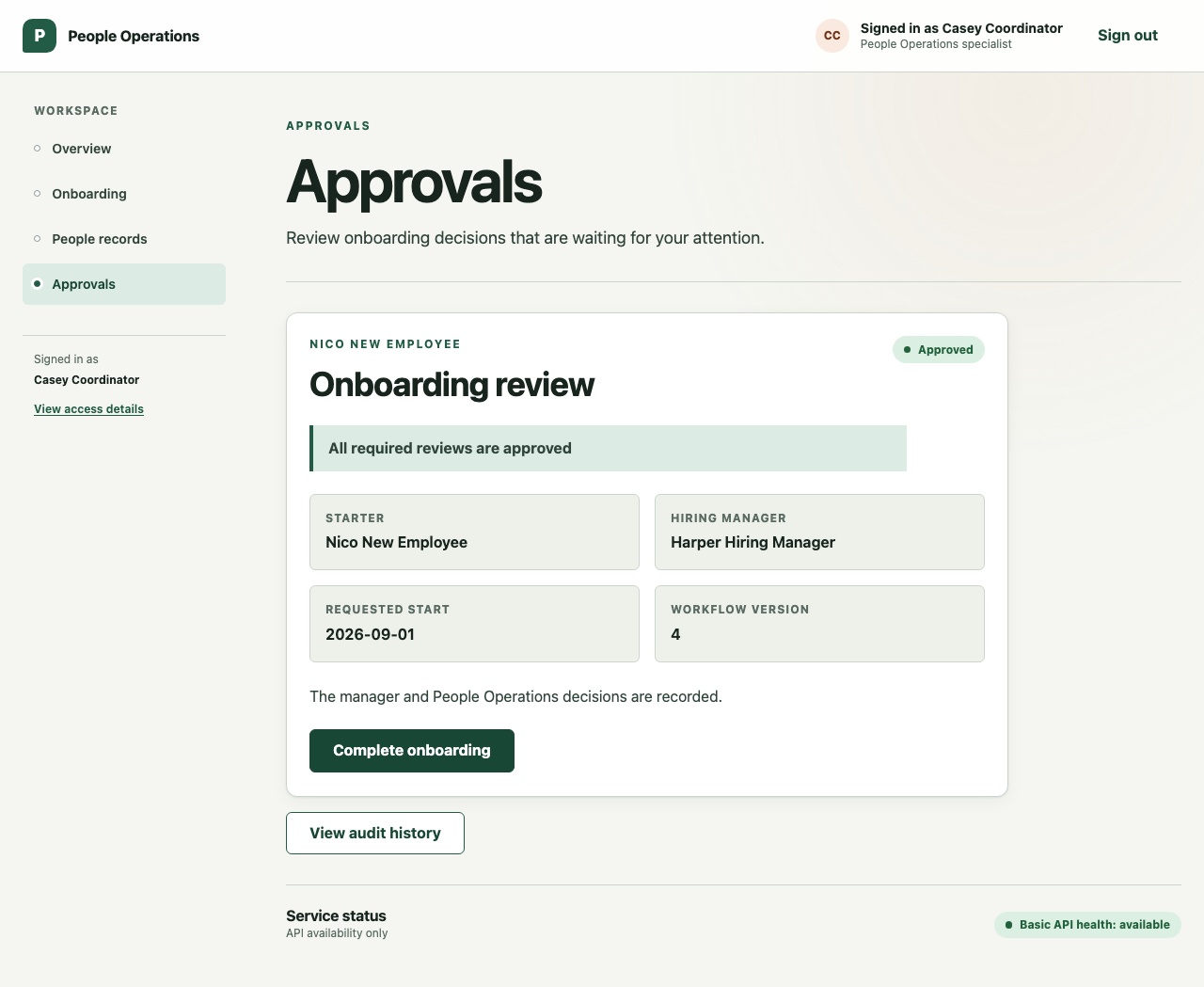
Only that approved workflow version can create downstream projections. The outbox checks persisted status and version inside the same transaction that creates the provider work. A unique request, workflow-version, and projection-type key suppresses duplicate rows. Workers use stable idempotency and correlation identifiers, bounded retries, and separate append-only acknowledgement evidence.
The completed state makes the handoffs visible rather than treating “API request sent” as success.
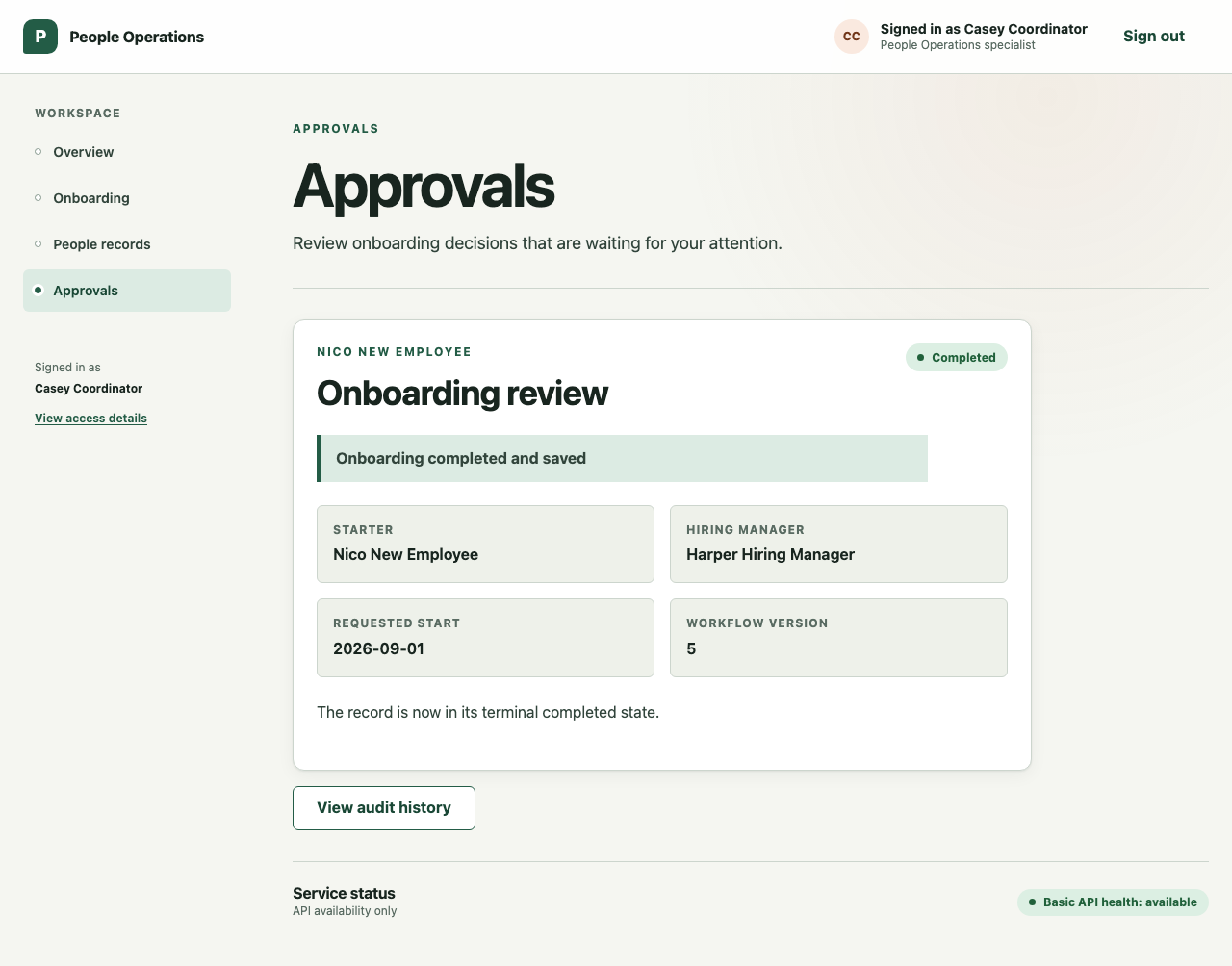
For identity provisioning, the production boundary can use SCIM, the IETF standard for cross-domain identity management. The owned people system supplies an approved projection; the identity provider remains responsible for its directory, authentication, authorisation, and account lifecycle controls.
Exceptions are part of the product
Real employee onboarding workflows do not stay on the happy path.
A manager may reject a request. A start date may change. A source person may match two employees. Required information may be missing. A payroll provider may reject a projection. An identity acknowledgement may never arrive. A migration total may disagree with the source.
Those are not edge cases to hide behind a generic error message. They are the operating work.
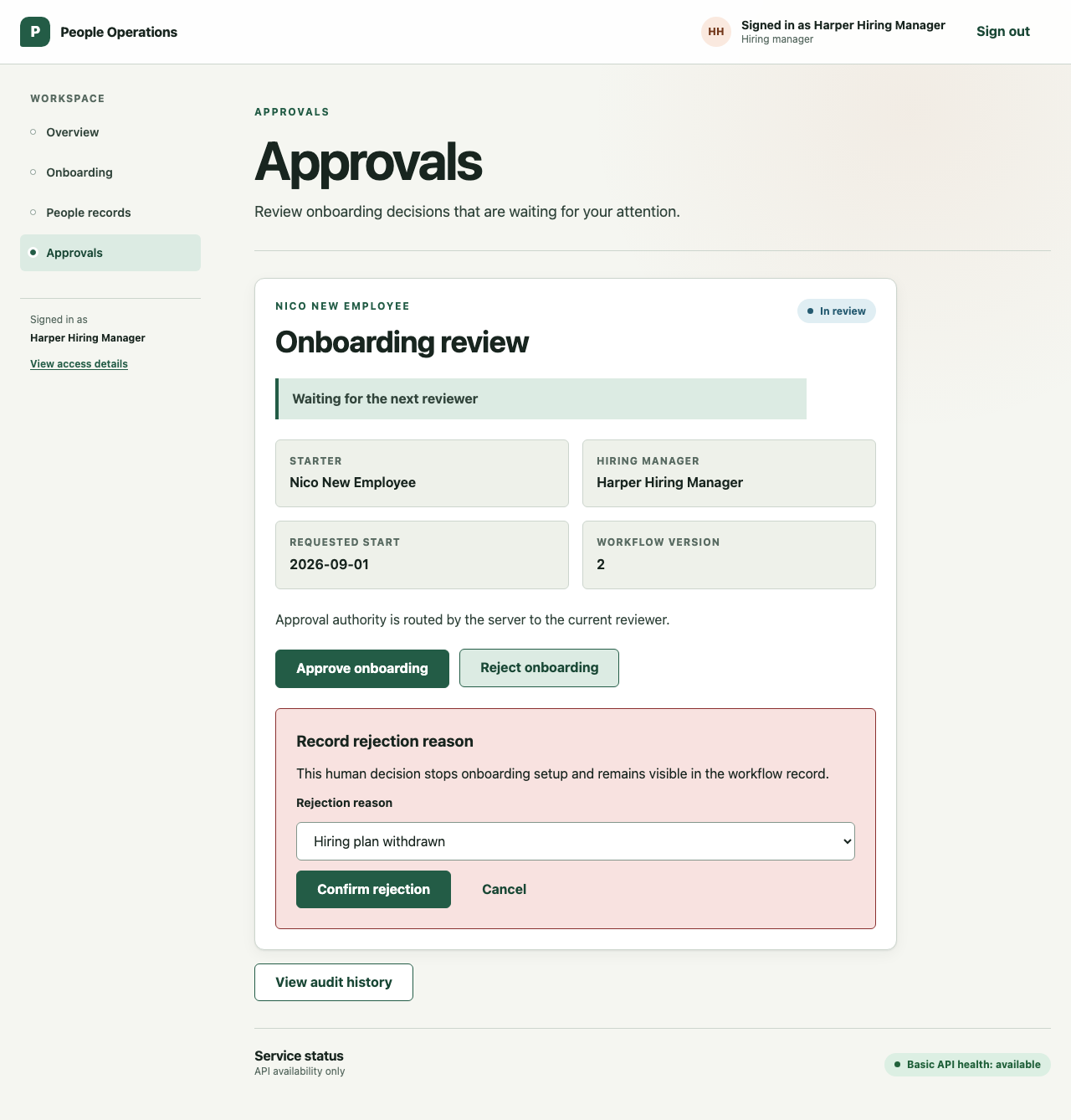
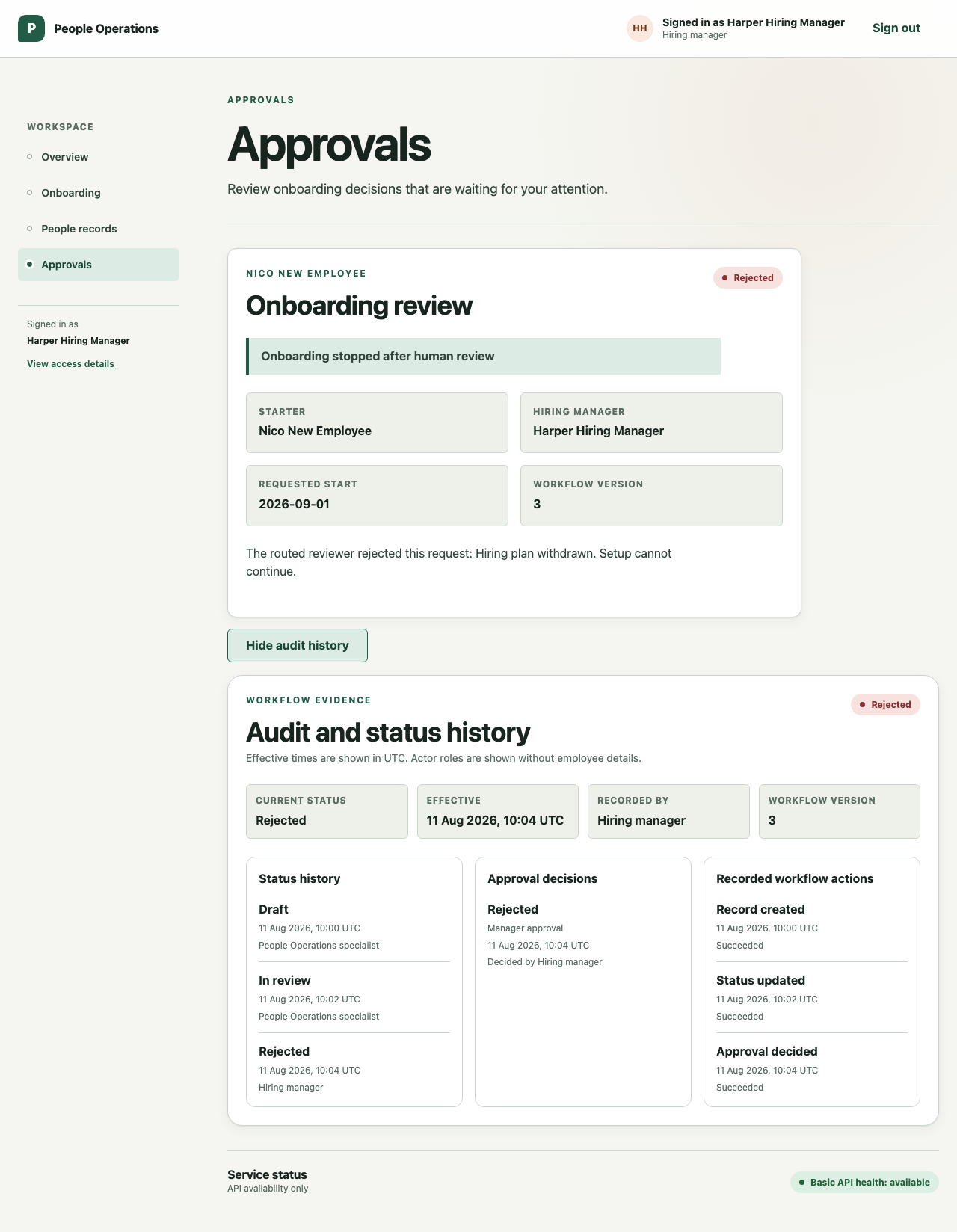
The rejected path retains the reviewer, decision, reason, state transition, and what must happen next.
Its history remains available after the current status changes.
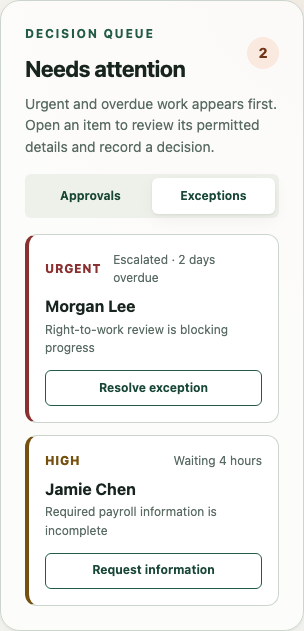
On a narrow screen, the exception queue keeps the next action and ownership readable for operators away from a desk.
Security is enforced at the record boundary
People data makes a polished role-aware interface insufficient.
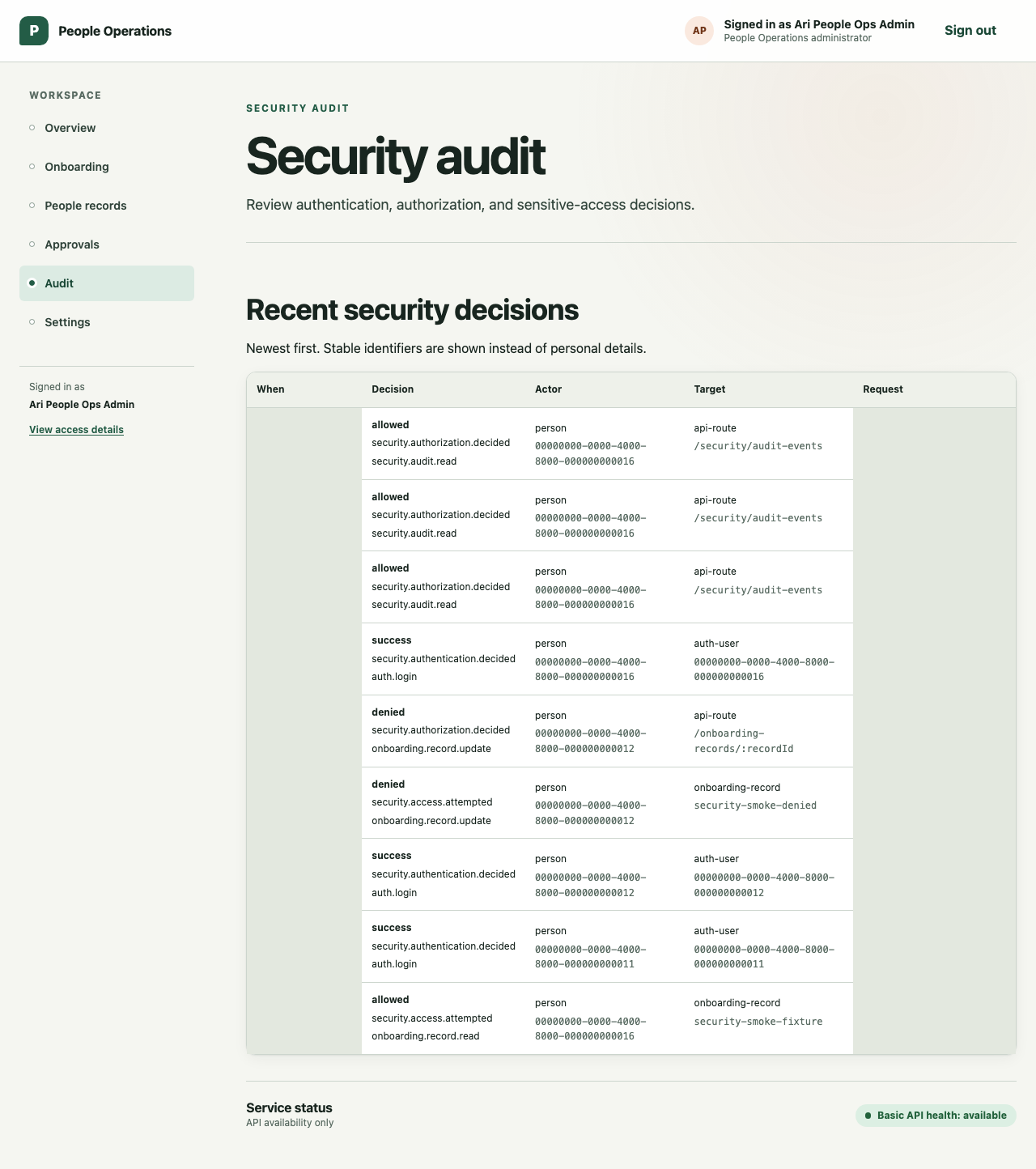
The application uses database-backed sessions, server-side roles and capabilities, field-bounded adapter payloads, safe audit schemas, and direct-route denials. An authenticated user who lacks a capability receives no protected data even if they request the URL directly.

The administrator can review the denial without exposing employee fields, credentials, tokens, request bodies, or raw provider payloads.
The build is a foundation, not a completed privacy or security assurance programme. A real rollout still needs jurisdiction-specific data classification, retention, access review, threat modelling, penetration testing, encryption and key management, incident response, restore testing, and accountable production ownership.
What was implemented and what remains
| Capability | Week 10 implementation | Next work for live operation |
|---|---|---|
| Employee record | Effective-dated people, employment, organisation, actor, workflow, decision, and audit foundations | Complete the agreed production profile, retention model, privacy controls, and all jurisdiction-specific requirements |
| Migration | Staging, idempotent import jobs, mapping, validation, AI-assisted match proposals, reconciliation, cutover evidence, and rollback boundaries | Rehearse against a redacted production-shaped export, verify every mapping, and run an approved parallel/cutover plan |
| AI copilot | De-identified provider contract, deterministic candidate ranking, validated cited proposals, confidence, model reference, and human review | Connect and evaluate a live model; extend carefully into plan assembly, policy interpretation, readiness, and exception preparation |
| Onboarding | Persisted lifecycle, routing, manager and People Operations decisions, exceptions, history, board, status, and employee views | Add the organisation's templates, policies, service levels, notifications, and remaining employee self-service actions |
| Downstream execution | Provider-neutral projections for payroll, identity, equipment, workplace, learning, and notifications with outbox and acknowledgement evidence | Connect real providers, verify schemas and scopes, test retries and reconciliation, and define operational ownership |
| Security | Sessions, seeded role model, API capability checks, access denials, and safe security audit events | Connect production identity, complete privacy/security assurance, rotate secrets, and operate access reviews |
| Delivery | Non-root containers, health/readiness contracts, CI, customer-managed deployment templates, observability, rollback, recovery, and release evidence | Deploy, load test, restore-test, monitor, rehearse rollback, and operate against service objectives |
This is why “AI built a global HR platform in six hours” would be the wrong conclusion.
The build created the architectural and operational spine for a bounded people operation. The remaining column is how that spine becomes a dependable company system.
Technology implemented
| Layer | Week 10 implementation |
|---|---|
| Browser application | React and Vite with responsive employee, manager, People Operations, and administrator surfaces |
| API | Node.js services for sessions, authorisation, onboarding, imports, decisions, projections, and audit |
| Persistence | PostgreSQL with 15 versioned Flyway migrations |
| Migration | BambooHR source adapter, staged ingestion jobs, mapping, validation, reconciliation, cutover evidence, and rollback limits |
| AI | Provider-neutral structured adapter with de-identified candidate aliases, evidence allow-listing, citation validation, confidence, and deterministic mocks |
| Workflow | Server-authoritative state machine, routing, policy validation, versioned decisions, and append-only history |
| Integrations | Payroll, identity, equipment, workplace, learning, email/collaboration, object-storage, and malware-scanning boundaries |
| Execution | Durable PostgreSQL outbox, retries, idempotency, correlation, acknowledgements, rejections, and safe failure evidence |
| Delivery | Hardened containers, customer-managed rollout configuration, health/readiness probes, structured logs, CI, rollback, and recovery runbooks |
| Verification | Unit, integration, release-evidence, security-smoke, responsive, accessibility, persistence, and Playwright system coverage |
What the browser evidence proves
The recovered editorial command runs four dedicated browser suites: the application shell, connected happy path, rejection path, and security smoke. Together they generate and verify 14 stable screenshots against isolated local services and PostgreSQL.
The browser evidence proves:
- People Operations can see a coherent onboarding board, status surface, and exception queue
- a draft can move through manager review and approval into completion
- the completed state survives a browser reload against persisted data
- rejection remains visible in current state and audit history
- AI assistance is presented as a proposal with confidence and human disposition
- restricted routes deny an unauthorised authenticated user
- the administrator can inspect safe security-audit evidence
- the mobile exception surface remains readable at 304 pixels wide
The unit and integration suites separately passed 171 checks, the release-evidence suite passed three checks, and both production builds passed.
This does not prove live model quality, a production HRIS migration, real payroll or identity delivery, global employment compliance, backup restoration, or sustained production reliability. Those require provider-specific and operational evidence.
How SwarmCraft structured the build
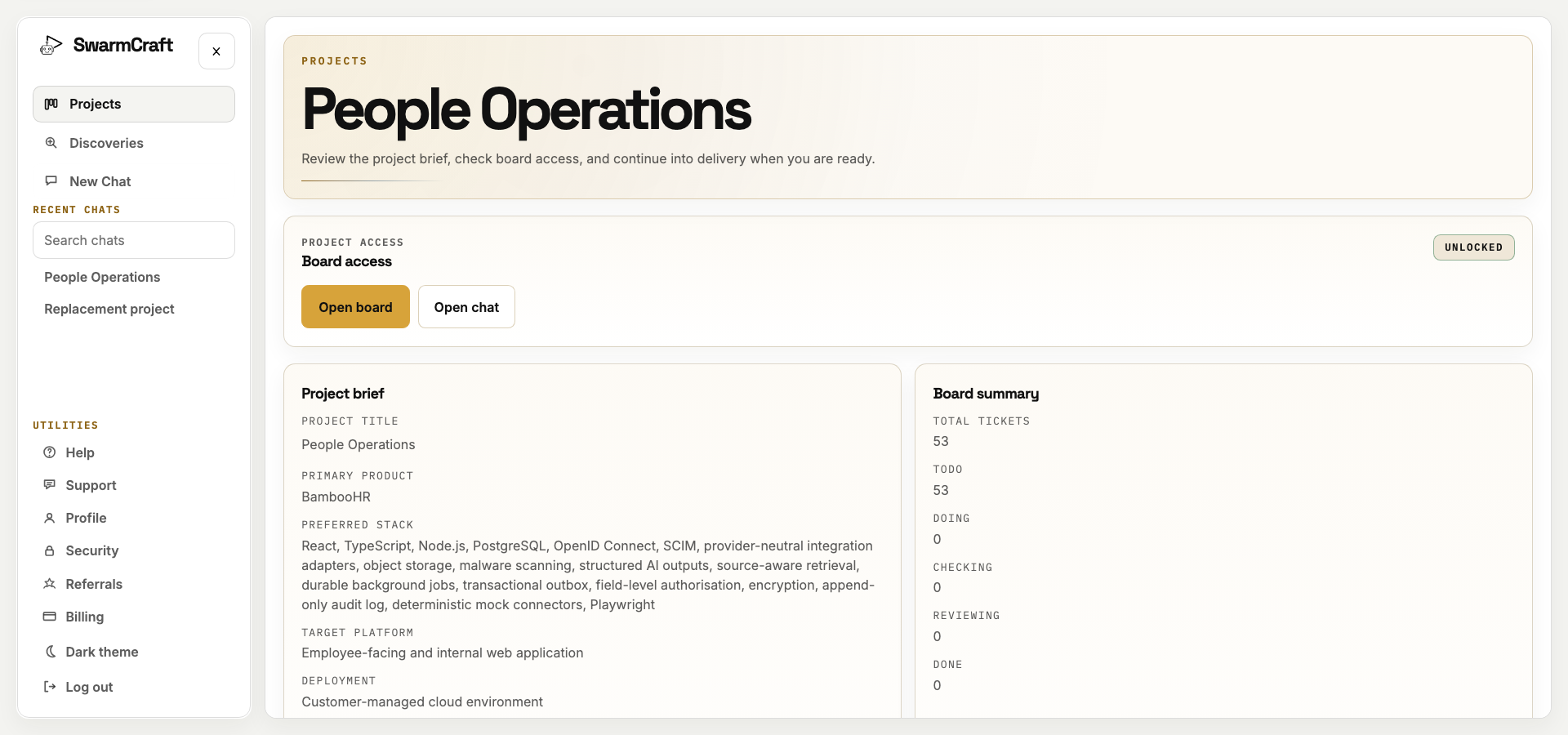
SwarmCraft created a 53-ticket People Operations project spanning repository foundations, identity, permissions, audit, employee records, onboarding policy, migration, AI matching, cutover, integrations, responsive UI, browser evidence, deployment, observability, rollback, and recovery.
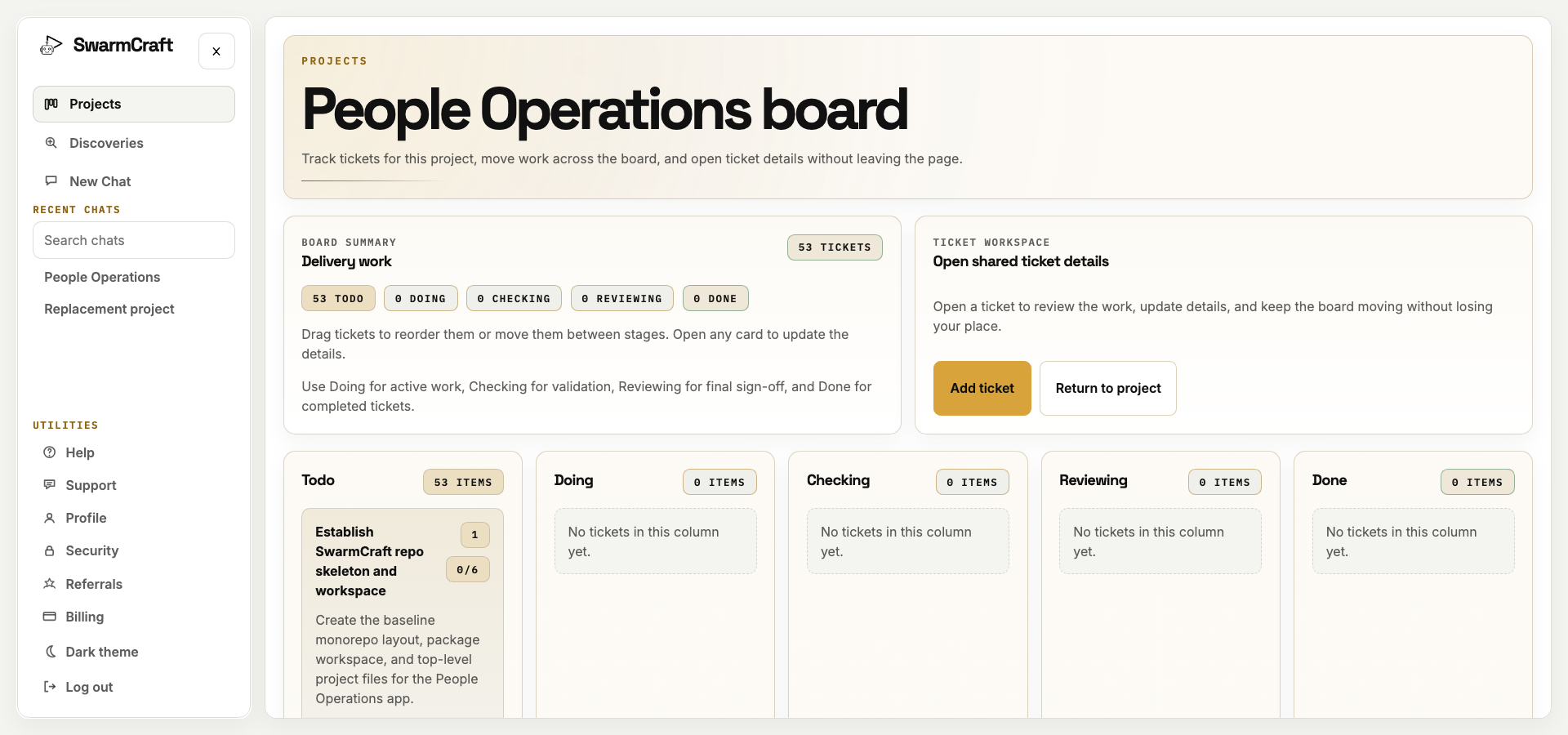
The board image is the initial plan. The build manifest is the completion record: 53 tickets selected, 53 done, zero open, zero blocked, and zero manual-review outcomes.
The order is important. The build did not begin with a dashboard and add data integrity later. It established persistence, sessions, permissions, audit, workflow state, migration boundaries, AI contracts, and provider interfaces before completing the operating screens and browser proof.
That is the more powerful AI story. AI did not merely generate onboarding copy inside the finished product. An AI build agent helped translate an operating model into a sequenced, tested system, while the product itself gives AI a narrower interpretive role inside deterministic controls.
What should remain outside the owned record
| Record or responsibility | Appropriate owner |
|---|---|
| Effective-dated person, employment, organisation, onboarding, decisions, and integration history for the migrated population | Owned people operations application |
| Authentication, directory policy, groups, and access enforcement | Identity provider |
| Pay calculation, tax, statutory deductions, banking details, and payment execution | Payroll and banking providers |
| Background screening, right-to-work evidence, and specialist legal determinations | Approved specialist systems and accountable professionals |
| Device inventory and fulfilment | Equipment or asset-management system |
| Course content and learning completion where a specialist platform remains necessary | Learning provider |
| Signed contracts and controlled source documents | Approved document or records repository |
| Country-specific employment interpretation and accountable employment decisions | Qualified people and legal owners |
Owning the employee record is not an excuse to centralise secrets, duplicate specialist data, or let one application claim authority it does not have.
The owned core should retain the minimum facts and evidence needed to coordinate the operation. Specialist providers receive the minimum approved projection they need and return a correlated acknowledgement. That architecture makes replacement possible without turning the new system into another bloated suite.
What must be true before you retire the HRIS
Do not cut over merely because an owned employee-record foundation exists. Keep the current HRIS as a temporary source and continuity boundary while the organisation discovers the real operation, reduces change risk, rehearses migration, and proves that the replacement can carry accountable work.
Before retirement, the exit plan should establish that:
- every employee population, effective-dated relationship, document, workflow, report, and integration in real use has been inventoried
- each capability has an explicit destination: the owned people operation, a suitable specialist provider, a later migration phase, or removal because it is unused breadth
- payroll, benefits, time, leave, identity, screening, banking, and country-specific obligations can receive the minimum approved data they need without the HRIS remaining the central record
- compensation, performance, workforce-planning, and labour-administration workflows that genuinely matter are implemented, procured separately, or sequenced after the first cutover
- responsibility for regulatory change, privacy, security, availability, support, and audit has moved from an assumed vendor bundle to named accountable owners
- required adapters replace the parts of the incumbent marketplace the organisation actually uses
- a production-shaped migration has been reconciled, parallel operation has passed, downstream acknowledgements are trustworthy, and rollback or forward recovery has been rehearsed
- a named engineering and operational team can maintain the owned system after launch
If any of those conditions are unresolved, keep the incumbent in place while completing the discovery and evidence—not as the chosen end state, but because the cutover risk is not yet controlled. Deep Discovery is the appropriate route when record ownership, global operating contexts, provider boundaries, migration, or assurance still need to be worked out.
This remains a global decision made context by context. The destination can still be an owned employee record; the sequence should reflect the populations, jurisdictions, specialist providers, and change capacity involved.
What this says about AI-built people operations
The three layers matter because each solves a different problem.
The owned employee record removes the structural dependency. The company controls the schema, history, migration path, and operating model.
The AI operations copilot reduces interpretation work. It can make messy inputs understandable, prepare a structured plan, identify conflicts, cite evidence, explain readiness, and assemble exceptions for accountable reviewers.
The governed execution layer turns approved intent into reliable action. It decides whether a transition is valid, whether the actor is authorised, whether an approval covers the current version, what each provider may receive, how retries behave, and what evidence remains afterward.
None of the three is sufficient alone.
An owned database without useful interpretation becomes another manual admin tool. An AI copilot without an owned record remains a helper floating above somebody else's product. Automation without governance can accelerate the wrong decision into payroll and identity systems.
Together, the layers create a focused operating system:
AI prepares. People decide. Deterministic software executes and remembers.
That is the product story behind week ten.
What operator-builders should take from week ten
Employee onboarding is not one form and a checklist. It is a coordinated change to person, employment, organisation, access, pay, equipment, learning, and audit state.
The conventional SaaS answer bundles those concerns into a broad HR platform and charges the company to keep its employee record there. That platform may need to remain during discovery, migration, and parallel operation, but its accumulated breadth should become an exit inventory—not a permanent specification for the owned system.
A capable team can define the population and operation it is prepared to own, migrate the record through explicit controls, use AI to interpret evidence without delegating authority, and execute approved changes through deterministic provider boundaries.
The practical sequence is:
- Define the employee record and workflows the company genuinely needs.
- Decide which records to keep, integrate, migrate, or own.
- Rehearse migration and cutover with reconciliation, approvals, and stop conditions.
- Put AI inside a bounded proposal contract with evidence and human disposition.
- Put every material change behind permissions, lifecycle rules, and versioned approvals.
- Project only approved minimum data to specialist systems and wait for accountable acknowledgement.
- Operate the system with real teams, measure exceptions, and extend it from observed work.
Week ten does not prove that a generated application is ready to replace any HRIS tomorrow. It proves something more useful: the path from one replaced workflow to an owned people operation can now be made concrete, testable, and economically discussable.
The system of record is no longer automatically the thing a company must rent. It is a boundary the company can choose—if it is prepared to own the consequences as carefully as it owns the code.
Choose a discovery route
Replacing an employee record requires more than a short workflow brief. If interviews, source material, migration, controls, provider boundaries, or record ownership need structured investigation, explore Deep Discovery. It can determine what to keep, integrate, migrate, or own before implementation begins. Deep Discovery is currently available through a limited account-enabled rollout.