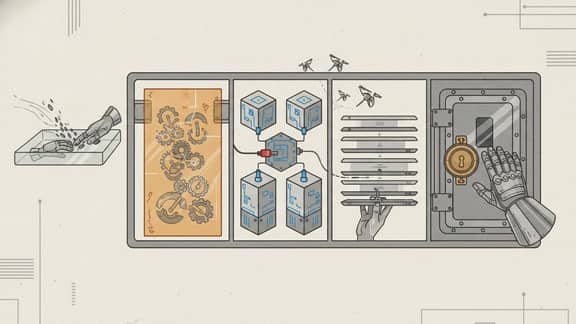
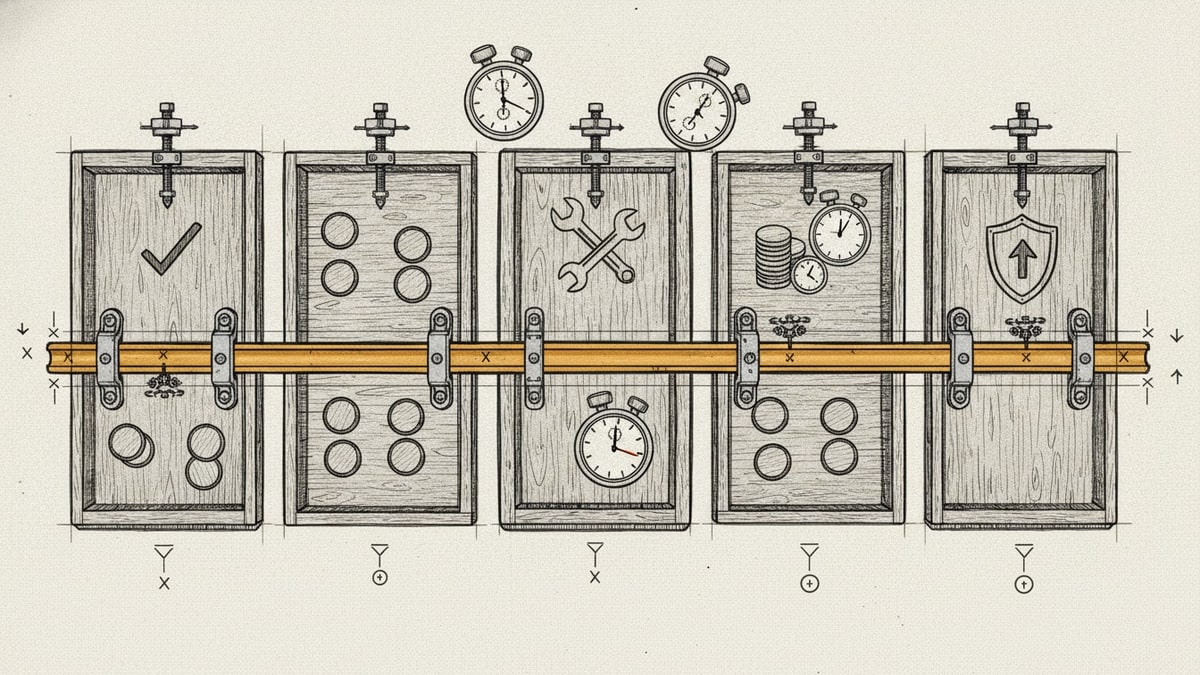
HR stack sprawl begins when the HR system still owns the employee record, but nobody owns the journey between an approved hire and a ready employee.
Recruiting marks the candidate hired. HR prepares a contract and creates the worker. Payroll waits for tax and bank details. Identity needs a start date, manager, location, and role. IT needs equipment and application access. Facilities needs a site decision. Finance needs a cost centre. The manager needs a plan. The employee needs one trustworthy view of what happens next.
Each team may use the correct specialist system. The failure is the path between them.
The start date is copied into a project board. Access requests move through service tickets. Equipment appears in an asset tool and a spreadsheet. Sensitive documents travel through email. Approvals happen in chat. A separate onboarding app sends reminders. Managers attend status meetings because none of those products can explain whether the employee will actually be ready.
That is not simply an HR software problem. It is a workflow-ownership problem expressed as software sprawl.
Microsoft’s documentation describes identity lifecycle work through the familiar joiner, mover, and leaver phases. The model is useful beyond one identity product because it makes the trigger and lifecycle state explicit. NIST’s Privacy Framework provides a broader way to manage privacy risk when personal data flows through complex systems. The UK Information Commissioner’s guide to data-protection principles includes data minimisation: personal information should be adequate, relevant, and limited to what is necessary for the purpose.
Together, those principles point away from copying the whole employee record into every coordination tool. Preserve trusted records, define lifecycle events, and give the cross-system operation an accountable owner.
Why HR stack sprawl hides inside onboarding
Onboarding looks like a checklist, but it is really a chain of dependent decisions.
Consider one new employee:
- A hiring decision is approved with a role, manager, location, start date, employment type, and compensation.
- The employment agreement is issued and accepted.
- HR creates or confirms the authoritative worker record.
- Payroll and benefits collect the information they are entitled to hold.
- Identity creates the account using approved worker attributes.
- Application, group, device, and physical-access requests are derived from role and location.
- IT, security, facilities, finance, and the manager accept their responsibilities.
- Exceptions are resolved without exposing unnecessary employee data.
- Readiness is checked before the start date.
- The employee starts, receives support, and completes required acknowledgements.
- Final outcomes are written back to the systems that own them.
Most HR stacks represent fragments of this path. The applicant-tracking system knows the candidate. The HRIS knows the employee. Payroll knows pay. Identity knows accounts. The service desk knows requests. The asset system knows devices. Learning knows assignments. The document system knows signatures.
HR stack sprawl appears because no operation owns the transitions, dependencies, exceptions, and proof between those records.
The nine states hidden inside “onboarding”
An onboarding status such as “in progress” is too vague to govern real work.
| State | Question the operation must answer |
|---|---|
| Authorised | Has the hire and employment basis been approved by the accountable people? |
| Accepted | Has the candidate accepted the agreement, and are any conditions still open? |
| Worker record ready | Does the authoritative HR record contain the minimum accurate attributes required downstream? |
| Provisioning approved | Which identity, applications, groups, equipment, and locations are justified by role? |
| Owners acknowledged | Have HR, payroll, IT, security, facilities, finance, and the manager accepted their tasks? |
| Dependencies clear | Is any task waiting on a start date, location, contract condition, inventory, approval, or another task? |
| Exception active | What differs from the normal path, who can decide it, and when is escalation due? |
| Ready to start | Are the minimum employment, access, equipment, workspace, and manager conditions satisfied? |
| Verified and closed | Did the employee start successfully, and were final outcomes recorded in the right systems? |
When one tool offers only a checklist, teams buy another for approvals, another for reminders, and another for dashboards. The resulting tool sprawl is a symptom of a weak state model.
Where ownership breaks across the HR stack
| Workflow moment | Trusted record | Where software sprawl appears |
|---|---|---|
| Hiring decision | Applicant tracking or approved recruitment record | Offer facts are copied into email, documents, spreadsheets, and HR forms with different values. |
| Employment terms | Contract, document, or employment system | Acceptance, conditions, and changes are tracked outside the onboarding plan. |
| Employee identity | HRIS or designated worker master | Several tools create their own employee profile, identifier, manager, location, and status. |
| Payroll readiness | Payroll and approved benefits systems | Sensitive bank, tax, compensation, and benefit data leaks into general coordination tools. |
| Digital identity | Identity provider | Accounts are created from stale or incomplete attributes, and failed provisioning is invisible to HR. |
| Application access | Identity, service-management, or application owner | Default bundles, manual approvals, and direct messages create excessive or late access. |
| Equipment | Asset or service-management system | Device requests, stock, shipping, receipt, and assignment use separate status definitions. |
| Physical workplace | Facilities or physical-access system | Site, desk, badge, and safety requirements are coordinated by email and local sheets. |
| Manager preparation | Onboarding operation | Goals, introductions, schedule, support, and role-specific preparation have no accountable record. |
| Learning and policy | Learning, policy, or compliance system | Assignment and completion are copied into a dashboard rather than referenced from the authority. |
| Exception handling | Owning specialist system plus onboarding operation | Visa, screening, accommodation, delayed equipment, changed start date, or missing approval is resolved in private messages. |
| Closure | HRIS plus specialist records | A checklist closes even when access, equipment, payroll, or employee support remains unresolved. |
A useful software audit therefore cannot stop at the application inventory. It must trace one employee lifecycle event and show where identity, state, ownership, evidence, and due dates diverge.
The real cost is not the HRIS licence
SaaS costs are visible on invoices. HR software total cost of ownership also includes the work created between products.
Duplicate employee records
The same name, manager, role, location, start date, worker type, and contact details appear in the applicant system, HRIS, payroll, identity, onboarding app, service desk, learning platform, spreadsheets, and local team lists. Corrections are applied unevenly, so every handoff needs another validation.
Repeated approvals
The position was approved during hiring, but finance approves the cost centre again. The manager approved the hire, but IT asks separately whether the person needs standard access. Security reviews entitlements after they have already been provisioned. Repetition feels safe while obscuring which approval is authoritative.
Status chasing
HR asks IT about the laptop. IT asks the manager about applications. Payroll asks HR about the start date. The manager asks everybody whether the employee is ready. Meetings and messages become a human integration layer because no shared state exposes acknowledgements, blockers, or the next decision.
Context reconstruction
Downstream owners receive a name and date without the approved role, location, employment type, access profile, delivery constraints, or exception context. They repeat discovery or make assumptions. The same deficiency is then compensated for with longer forms and more fields.
Over-provisioning and delayed removal
Access bundles are copied from another employee because role rules are unclear. Temporary access becomes permanent because nobody owns review. A moved or departed worker follows a different workflow from the one used to join them, leaving stale entitlements and equipment gaps.
Privacy exposure
General project boards and chat channels collect compensation, bank details, tax data, identity documents, health or accommodation information, screening results, private contact details, and contract facts because the operation has not defined what each participant actually needs.
Reporting reconciliation
HR reports time to hire. IT reports ticket completion. Identity reports account creation. Payroll reports setup. Managers report readiness from a spreadsheet. None of those measures alone answers whether employees started ready, which dependency failed, or how often manual intervention was required.
Administration and integration
Every extra surface adds licences, permissions, workflows, fields, notifications, connectors, retention settings, training, security review, vendor management, renewals, and support. A connector that creates a ticket is easy. One that handles changed dates, duplicate workers, rejected requests, failed writes, reopened work, and audit history is not.
This is SaaS waste even when every seat is assigned. The software waste is duplicated data, repeated interpretation, status chasing, reconciliation, privacy exposure, and proof.
Why more onboarding automation can make the stack less trustworthy
Automation is useful when the event, authority, state, and failure path are understood. It accelerates confusion when they are not.
For example:
- an accepted offer creates accounts before an employment condition is satisfied
- a changed start date updates the HRIS but not equipment shipping or identity activation
- an integration creates a service ticket but never confirms that a team accepted it
- a role template grants applications without an entitlement owner reviewing exceptions
- a manager change updates the organisation chart but not approvals or inherited access
- an AI summary copies sensitive employee context into a general collaboration surface
- a completed IT task marks onboarding ready while payroll or workplace access remains blocked
- reminders continue after the worker withdraws because cancellation is not a governed state
The question is not whether automation or AI is present. The question is whether the organisation can explain the trigger, source attributes, decision rule, accountable owner, review boundary, failure handling, and authoritative write-back.
Automation moves tasks. Workflow ownership governs the employee lifecycle and its consequences.
The safe boundary around employee data and employment systems
Software consolidation should not turn an onboarding workflow into a shadow HRIS, payroll system, identity provider, document vault, or compliance archive.
Keep these boundaries explicit:
- HR master record: authoritative employee identity, employment status, manager, role, location, effective dates, and organisation history stay in the designated HR system unless there is a deliberate record migration.
- Payroll and benefits: bank, tax, compensation, deduction, benefit, and statutory processing data remain in authorised payroll and benefit systems with tightly limited access.
- Identity and access: account state, authentication, groups, entitlements, privileged access, and revocation remain governed by identity and application owners.
- Contracts and documents: signed agreements, identity evidence, screening records, and regulated employment documents remain in approved stores with retention and access controls.
- Privacy and sensitive cases: health, accommodation, investigation, immigration, and other restricted data should not be copied into general coordination fields.
- Local employment obligations: jurisdiction-specific checks, notices, training, payroll, safety, and recordkeeping remain with accountable legal and operational owners.
The onboarding operation should own only the coordination records it needs: event reference, workflow state, accountable owners, due dates, dependencies, acknowledgements, exception category, approved outcome, and evidence pointers. It can reference protected facts without duplicating their contents.
That is a coherent operation: substantial enough to govern the outcome, narrow enough to preserve specialist authority.
How to run an HR software stack audit
Do not begin software stack rationalisation with vendor names. Select recent employee journeys: a normal hire, a remote or multi-location hire, an employee with an exception, a changed start date, a manager or role move, and a leaver.
Trace them end to end:
- Name the lifecycle event. Identify what authorises the joiner, mover, or leaver process and the effective date that governs downstream work.
- Mark trusted records. Decide where hiring, employee, payroll, identity, contract, asset, learning, and access records remain authoritative.
- Map required data. For each step, record the minimum attributes needed and flag sensitive values copied only for convenience.
- Follow ownership. Name the person or team responsible for every approval, acknowledgement, task, exception, escalation, and closure decision.
- Follow dependencies. Show which tasks can run in parallel and which require an accepted agreement, worker record, location, role, start date, inventory, or prior approval.
- Follow every channel. Include email, chat, meetings, local documents, spreadsheets, tickets, onboarding tools, identity workflows, and personal reminders.
- Inspect clocks. Compare start dates, task due dates, acknowledgement targets, provisioning windows, shipping lead time, escalation thresholds, and cancellation timing.
- Test changes. Follow a revised start date, manager, location, role, employment type, or withdrawal through every downstream system.
- Test failure handling. Check duplicate records, rejected approvals, failed integrations, unavailable owners, insufficient stock, late documents, and partially completed provisioning.
- Compare closure. Distinguish contract accepted, HR record ready, account created, equipment delivered, payroll ready, manager ready, employee started, and onboarding verified.
- Reconstruct evidence. Ask whether another authorised person can explain decisions and outcomes without searching private messages or exposing protected data.
- Assign one operation owner. Give a named team responsibility for the cross-system lifecycle path even while specialist teams retain their records and controls.
This creates meaningful software visibility. A normal SaaS spend management report can show overlapping subscriptions; the lifecycle trace explains why there are too many software tools around one employee outcome, why the overlap exists, and what can safely be removed.
What HR software consolidation should remove
Software consolidation is not forcing recruitment, HR, payroll, identity, devices, facilities, learning, contracts, benefits, and compliance into one enormous suite.
The safer target is duplicated coordination:
- employee setup spreadsheets beside the HRIS
- onboarding boards that copy sensitive employee fields
- separate trackers for IT, equipment, payroll, facilities, and manager readiness
- chat messages used as the only approval or exception record
- email reminders with no acknowledgement or escalation state
- duplicate role and application-access forms
- dashboards built from incompatible definitions of “complete”
- manual copying between applicant, HR, payroll, identity, service, and learning systems
- meetings whose main purpose is reconstructing status
- one-way integrations with no visible retry, rejection, or cancellation path
Keep the HRIS when it reliably owns employee facts and effective dates. Keep payroll, identity, document, asset, access, learning, and compliance systems authoritative for their specialist responsibilities. Consolidate the operating loop that makes people reconcile them by hand.
That is application consolidation at the employee-lifecycle boundary, not an unsafe attempt to put every employment record in one product.
When another HR platform is the right answer
A platform change is appropriate when the record or service boundary itself is wrong.
The organisation may need:
- reliable support for additional countries, entities, worker types, languages, or employment models
- payroll, benefits, time, or workforce controls the current architecture cannot carry safely
- stronger effective-dated records, permissions, audit, reporting, retention, or data residency
- enterprise organisation, position, compensation, talent, planning, or integration governance
- simpler core HR administration for a growing team
- global employment or employer-of-record services rather than another coordination layer
- lifecycle automation that deliberately joins HR and identity responsibilities
Use the Best HR software comparison when the authoritative HR platform is genuinely open. Compare the production boundary, not only feature lists.
If the current employee record is accurate and the pain begins when onboarding crosses into payroll, identity, IT, facilities, or the manager’s work, a platform migration may reproduce the same SaaS sprawl in a different interface.
When a focused operation is the better SaaS replacement
A focused SaaS replacement makes sense when the organisation can define one lifecycle operation that:
- starts from an authorised hire, move, or departure event
- references the authoritative worker and effective date
- derives a minimal plan from role, location, worker type, and approved policies
- routes work to the systems that should own it
- requires owners to acknowledge responsibility
- exposes dependencies, due dates, blockers, and exception decisions
- escalates unacknowledged or overdue work
- limits every participant to the data required for their task
- distinguishes specialist completion from employee readiness
- handles changes, cancellation, retries, duplicates, and reopened work
- writes approved outcomes back to trusted systems
- retains one auditable coordination history without copying protected records
These custom workflows should not become shadow employment systems. They should coordinate the accountable path and preserve evidence pointers while HR, payroll, identity, access, documents, and compliance retain their authority.
A practical decision test
Before buying, consolidating, or replacing anything, ask:
- Is the pain inside the HRIS, or after the employee lifecycle event leaves it?
- Which employee facts are copied into tools that do not need to hold them?
- Can every onboarding task name one owner, due date, dependency, and acknowledgement state?
- Does a start-date, manager, role, location, or employment change propagate safely?
- Are payroll and identity readiness visible without exposing protected values?
- Are access requests derived from approved policy rather than copied from another employee?
- Can exceptions be decided and reconstructed without searching chat?
- Do failed integrations, rejected approvals, duplicates, and cancellations have explicit states?
- Is “ready to start” distinct from each specialist task being marked complete?
- Can a mover or leaver reuse the same governed lifecycle model?
- Would owning one coordination operation remove more work and risk than replacing the HR platform?
If the answers point to one cross-system lifecycle path, own that operation first. It is a more defensible form of SaaS cost reduction than a broad migration driven by frustration.
Where to go next
If the HR record decision is still open, continue with Best HR software. If the practical pain is new-starter coordination, continue with employee onboarding workflow: how to automate it. If the current HRIS is under review, compare BambooHR alternatives, a Rippling replacement, or the other vendor-specific paths from the category comparison.
The core lesson is simple: reduce HR stack sprawl by making one employee lifecycle path legible. Keep protected records and specialist controls deliberate, remove duplicated coordination, and give one accountable team workflow ownership from authorised event to verified outcome.
Choose a discovery route
If interviews, source material, record ownership, controls, or migration need structured review, explore Deep Discovery. It can investigate whether to keep, integrate, migrate, or own records without presuming replacement is safe. Deep Discovery is currently available through a limited account-enabled rollout.